
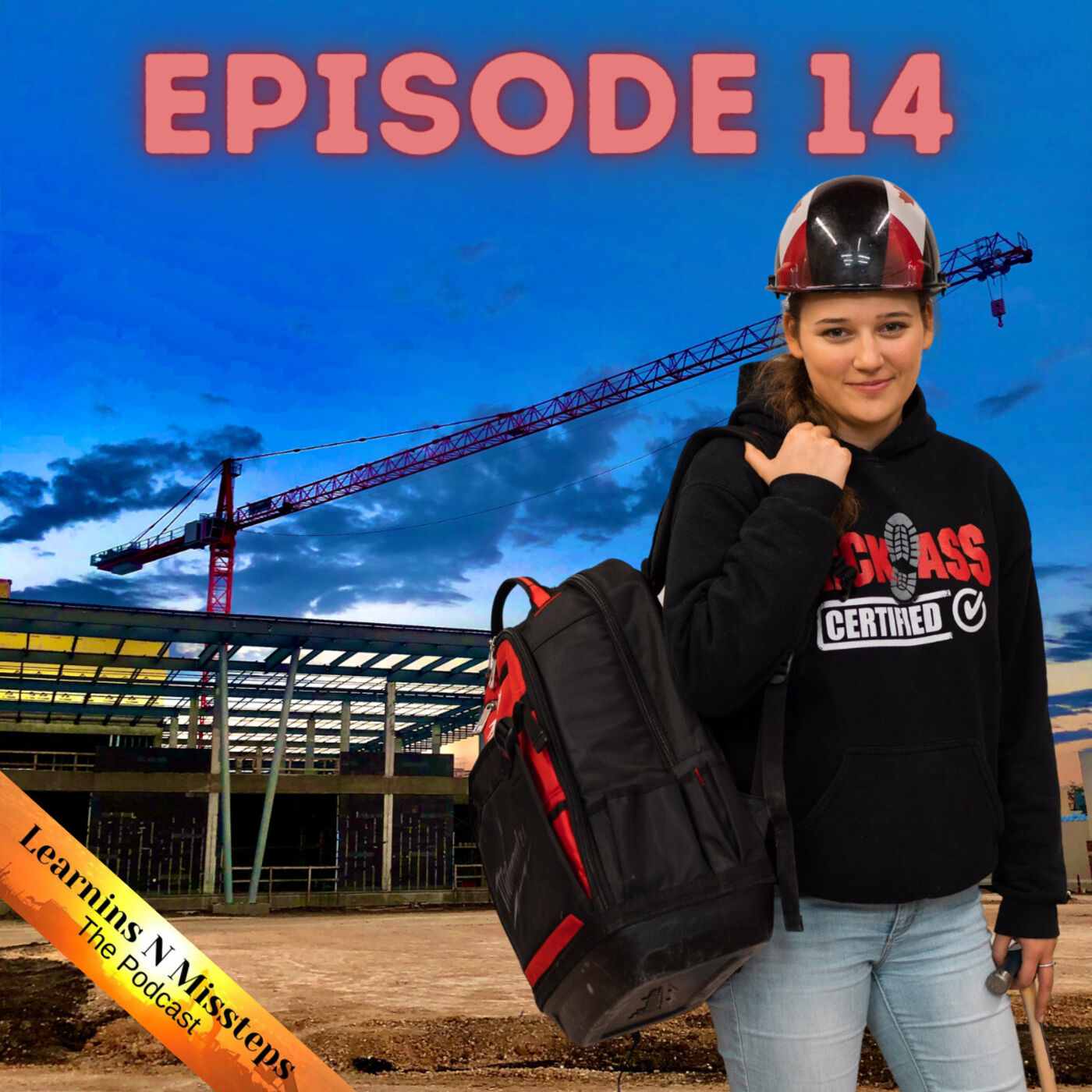
Episode 14: Making a come back when you think its all over with Dee Durant Electrical Apprentice

 Apple Podcasts

 Spotify

 Overcast

 Castro

 PocketCasts

 RSS Feed

 Amazon Music

 Audible

 iHeartRadio
This conversation with Miss Dee Durant will take you back to them younger days when you felt like any wrong decision meant the end of the world. Dee advocates for Careers in the Trades as an ambassador for Kick Ass Careers and her story is a solid example of what a young adult should do to discover what it is that drives them. She also gives us some pointers that will help us make the Construction Industry a more inclusive space.
Support the mission at:
https://www.patreon.com/learninsnmissteps
Resources:
https://kickasscareers.org/
Connect with Dee at:
https://www.linkedin.com/in/deedurant/
https://www.instagram.com/dee.d15/
Connect with us at:
https://www.facebook.com/learninsn.missteps.1/
https://www.linkedin.com/in/learnins-n-missteps-6525b41b7/
https://www.youtube.com/channel/UC4yLjr8swfqCt_vMp74oiXA
https://www.instagram.com/learninsnmissteps/?hl=en
Yeah, you're frozen. Weirdo. You actually have a pretty nice smile right now.
SPEAKER_02Yeah, that's actually really good.
SPEAKER_01Just leave it like that for us. You're listening to the Learnins and Missteps podcast, where we intend to change the image of careers in the trades. We celebrate the real men and women who have built careers in the construction industry by bringing their personal stories straight to you. I began my career as a plumber's apprentice in the late 1900s. Over the last 26 years, I've had the fortune of meeting some of the most resilient, intelligent, and inspiring people who happen to be construction workers. My career path as a plumber has provided me with experiences and opportunities I thought were inaccessible. And I want you to know that the trades are a place where dreams can come true. These stories are brought to you by three brothers who share a mother. I am Jesse, your host. Our in-house writer is Ernest, aka La Vos. Hello. And our co-host, Renee. Y'all ready? Yes, sir. What's going on? Do you remember feeling like the decisions you made as a 16, 17, or 18-year-old were like nails being put into your coffin? Ms. D. Durant takes us through her decision making as a young adult and really does a great job of reminding me what it felt like back when I was her age making a decision to build a career in the construction industry. This conversation is a perfect example of what an a young adult should do in order to discover what it is that drives them as an individual. And maybe it's because she has nine lives, or maybe it's just because that's the way life is. The world didn't end. And D also gives us just some straight talk about what we all could do to make our industry a more inclusive space. I think if we all just apply a little bit of what D offers in this conversation, we could all make a big difference in the future. Oh, for those of you that are interested in some exclusive content, early access to our episodes, and supporting the mission, we set up a Patreon account for y'all to contribute even more than you have so far. We've got four different levels. Any level that you sign up for will get you special recognition on the video version of these podcast episodes that we're now releasing on YouTube. We got a YouTube channel, baby. Watch out. We'd love to be able to share your name and let everybody else out there know that you're behind us. So you can find each of the four levels to sign up and contribute at patreon.com slash learnings and missteps. Uh we love you guys, and here we go. All right, so here we are with Miss Dee Durant, um, who is up in Canada. What part of Canada are you in right now, Miss D? Southern Ontario. Southern Ontario. So near Toronto. What's the weather like up there right now?
SPEAKER_02You know, it's actually been really warm recently. Currently, because it's the morning, it's only five degrees uh Celsius. Um, but recently it's been actually quite warm. We've gotten up to like 10 and 11.
SPEAKER_01So wow.
SPEAKER_02Really exciting.
SPEAKER_01I can tell you're enjoying that.
SPEAKER_02See, I actually I'm the weird one where I actually prefer the colder weather.
SPEAKER_01Why?
SPEAKER_02I find it so much easier to breathe. Like I know that sounds really, really weird, but negative 20, negative 30, all of that, it's actually warmer to like feeling than like negative five or negative 10 because the colder you get, the crisper it is. And it's the hum, it's like the moisture that really kind of gets you. So I I actually really prefer a solid negative 25 night because the air is just so crisp, you can see so far, it's it's incredible.
SPEAKER_01So I'm trying to do some math because I don't know what the conversions are.
SPEAKER_00Yeah, I was straight up gonna ask you, it's like what is that in Fahrenheit?
SPEAKER_02We were actually taught how to convert, but of course, I forgot that.
SPEAKER_01In Fahrenheit, it's 39 degrees in Toronto right now.
SPEAKER_02That sounds about right, yeah.
SPEAKER_01Yeah, that's good weather. I like that. So we got to connect via Shannon Tomosco, who's who's like the ultimate networker. Yes, super active on LinkedIn, and and more importantly, just a huge advocate um for with and through kick ass careers. Yes. What do you what do you know about kick-ass careers, D?
SPEAKER_02Well, kick ass careers is absolutely incredible. It's founded by Jamie McMillan, um, and she's up here in Canada, but her business partner is actually in the States. So we're an international company. Um, we have ambassadors from the States, and we also have ambassadors from Canada. We are diverse in that way, and we're always looking to be more diverse. And currently we have more female ambassadors than male, but we are actually both. We we don't just cater to women in the trades. We um our mission is just kind of to like end the stereotypes with uh what regarding the trades, and and my entire journey into the trades was just covered in stereotypes. So I'm very passionate about ending those stereotypes so that um somebody else, whether you be uh male, female, or or any, I I don't know what um all of them are right now. I I don't want to be politically incorrect, but whatever you identify as, you can enter the trades and have that as a viable option instead of having it looked down upon. So that's mostly what we do at Kick Ass Careers, and we like to start young. So Jamie is incredible at speaking, and she actually will start uh doing presentations with kids in elementary school, so grades junior kindergarten to grade eight is what we usually have in up here in Canada. Um, so we don't really have middle schools. You can go to a middle school, but it's not really that popular. So we do presentations there, and then we also do a ton of presentations with high school students. So we cater more to letting kids know that you can go into the trades and and you can have um a rewarding career and life from the trades.
SPEAKER_01That is noble work, and thank you, D, and everybody else's kick-ass careers that's doing that work. I started my career, the trades in 1995. I wasn't born. Thank you. Thank you for that.
SPEAKER_02I was one year old. I was born in 2000.
SPEAKER_01Nice, that is so awesome. We might we might edit that out. Yeah, all right. I feel loaded down too. It was how should I say, I knew I enjoyed the work, but it was very difficult, like in my head, because everybody around me saw it as a failure.
SPEAKER_02Oh my gosh, yes.
SPEAKER_01And and you mentioned that you had to um overcome a bunch of stereotypes on your journey. Can you tell us about some of that?
SPEAKER_02Yeah, so I just want to start off by saying my parents are incredible people. Um, my family is my sister, I also have an older sister who I look up to so much. So they always supported me. So my stereotypes were actually from my schools. Um so elementary school, it was never mentioned at all. And then I get into high school, and we have this uh assembly for the grade nines in high school, and it's just like, hey, these are what you can do. And the one thing about my high school specifically, I'm not sure if this is like an Ontario thing, but our levels of classes actually go university, college, and then like it goes down to like local. So um, if you're in university classes, you're the smart group. If you're in college, you're like you can kind of get it, but like you're not university.
SPEAKER_04Sure.
SPEAKER_02And then anything under that, you're just what are you doing with your life? That's the stereotype.
SPEAKER_01Wow, okay.
SPEAKER_02And and that's really strong. And um, that never really bothered me until I started considering the trades. And and I dropped down to a college level class because I was all university. I'm actually like, I'm a geek, really. Like I'm an I'm a not not a geek, I'm a nerd. Um, and I wear that title proudly because I love school, I love learning. If I'm not learning, then I'm not happy, um, which is also why I love the traits, because I'm always learning. So I dropped down from university to college because I had realized I'm not going to university. So why would I stress with that level of education when I could get a more practical education in the college level? So dropping down was actually really emotionally difficult for me. And and it shouldn't have been because I all of my friends were all in the university stream. I was with a bunch of people I had never taken classes with before, and a bunch of people that this is gonna sound really horrible, but I didn't really socialize with because we're kind of led to believe that the university level students are better, we're higher up. Like it's literally a tiered system. Um, and that looking back now, that really bothers me. But also, why would you call it university level? Like what's so special about university over college or even just trade school? Like trade school, that would be considered uh probably local level knowledge. Like it's it's just it's built into the system. Yes, and you don't realize it until you're out looking back. So when I got uh when I was in high school in the grade nine assembly, um we were told about all of these career paths we could choose and and how to like focus on things, and um, we were taught the tier of of classes, and and nobody really mentioned anything about the trades. Um, so I never even considered it. Um, and then grade 12 came along. So, well, technically grade 11 because I started changing my career path in grade 11, but it was late grade 11, so nothing changed until grade 12. I was going to college open houses, and I had gone to the Royal Military College here in in uh Ontario, and I had said, okay, I want I want to join the military, whatever. Like, um, what do I have to do and all this? Um, and the reason I want to join the military is because both my parents are police officers. So I've always felt that like need to like serve and and to like I love rules. Oh I know that's really weird, but I just I love rules, I love guidelines, and I'm not a rule breaker at all. So if you give me a rule, then I will follow it to a T. That's why I was really kind of looking for that that discipline. And so I had gone to the military college because what is that other than discipline? So I I thought for sure I would fit in, this is gonna be great, and then I realized I missed out by 1% on a grade, so that was like my drive home. Of course, it was through a blizzard. Um, I was just kind of sitting in the car, and my parents were sitting out front, and I was just so upset. I'm like, what am I gonna do with my life? I'm in grade 11, I'm 16, and um it's over.
SPEAKER_00You messed it up.
SPEAKER_02My life was over at 16. Um, but uh yeah, so I was driving home and I was just looking out, and this is so weird. But I remember being able to see the power lines. I was just sitting there and watching the snow come down, all of a sudden, out of nowhere, my dad's like, Have you ever thought about the trades? I'm like, the what's and um because you know, like the trades. And I'm like, Well, there's three trades, dad. Like, which one would I really be okay in? Let's think about this. So I'm like, construction, I don't like the smell of tar, so I can't really pave roads. So that's out. Um, plumbing, here comes my plumbing joke. I don't have the crack for it. Um electrical. I'm like, hmm, I could do electrical, and then the only real reason I chose electrical for sure was because I asked, I was actually before I switched to college, I was actually lined up to go to university for the study of meteorology. So I'm a huge weather nerd. I absolutely love the weather. And lightning is just an electric discharge. So I'm like, lightning electricity, yes, it's my soulmate. So then we started going to college open houses. I started going to those um and I started talking with professors, and and they were like, Oh, do you like being outside? I'm like, Yeah, of course I like being outside. Um, and they're like, Are you afraid of heights? I'm like, nope, but I am afraid of falling. I was then recommended to go into the power line technician program at one of our colleges. So, me not knowing anything about the about trades, I'm like, okay. So I signed up and um I got in. I went there and I did not like it at all. I enjoyed the theory, I loved doing all of that, but the climbing just it went so fast. The first day of climbing, I fell off the pole. And um, because they were teaching us how to uh freehand climb. So they wouldn't let us use our belt um to climb for the first little bit, but it had been raining for three days, and I am petite, I am I am five five, and I know that's like average for women, but compared to the guys I was with who are all like six, seven, like seven, eight feet tall, like their wingspan was massive, so they could easily hug the pole. I could not touch my fingers around the pole. So, how am I supposed to free climb? So, and because it had been raining, I slipped and I fell backwards.
unknownOuch.
SPEAKER_02And um, and that was really embarrassing for me. And then all of this self-doubt comes in, and then it just starts kind of eating away at you. And I I never really enjoyed climbing. Um, I fell behind very quickly because um, believe it or not, women and men don't have the same body. Um so men tend to be straight, their hips are the same width as everything above, and and women we were curvy, right? So um the belt did not fit me properly. So every time I fell, the belt would come up and it would catch me at my armpits when it was supposed to stay um around my hips. So imagine being 30, 40, 45 feet up, and you're dangling by your armpits. So no, it was not fun, and now we come back to my fear of falling.
SPEAKER_01Yes.
SPEAKER_02So I'm like, I don't really want to fall right now. Like I can look down, no problem, but it it's when that happens, I'm like, okay, it's happening. I'm I'm gonna die. My life is over. And um again, your life is over again. My life is over again, and um, so I'm like, I really don't want to die surrounded by a bunch of people I don't like. So I just climbed right back up, but I'm not a crier at all. I don't really cry. I'd like to think my tear ducks were taken out like at some point, but I was climbing up the pole and the instructor made everybody come down to my level and then climb up with me one step at a time. But guys, they can they can have the belt at their feet and then pull it all the way up, but women are center of balance is off, like compared to guys, so I could only have my belt at my uh chest, and then I could only put it up like two or three inches, and so it took me a really long time and I was really struggling, and then all of a sudden I just started bawling like 10 feet up in the middle of nowhere in this little tiny town called Ingersoll, and I was like, This is my life now, like yeah, yeah, and thankfully it was it was raining, so nobody saw the tears streaming down my face. You had some cover, but my glasses, my safety glasses had fogged up, so I could not see what I was doing. So I finally made it to the top, and then um I went down and I'm like, I don't want to do this. Um, and I started getting anxiety attacks every time I had to go to school um for climbing, not for the theory. And I was like, I don't want to do this. And I was living away from home, I was actually living in a hotel because this city is so small that there wasn't a residence for this program. The residence was literally a hotel that gave us a deal. So I didn't have a kitchen, everything I ate came out of a microwave and a little mini fridge that I'm still to this day convinced something died on. And that was basically it. So I started getting really, really sick. And I called my parents. I'm like, parents, I'm done. And and they were like, Are you kidding me? Like, no, you're not. Like everybody goes through challenges and this and that. Like, you just have to persevere, like you can do it, giving me like so many motivational speeches. And I was like, mm-mm. Mm-mm. So uh working. No, so I finally my parents got in the car and drove down, and we all sat down in my hotel room, and I started crying again. And it was just like, what is my face is wet? What is happening?
SPEAKER_01What is this stuff on my cheek?
SPEAKER_02But I'm leaking, something's leaking. So I think my parents are just like, you know what, it's your life. Like, drop out if you want, it's your life. And then so I did. I dropped out and um I finished off the semester, but I was now a college dropout, which comes back to my stereotypes of your college dropout, your life is over. Um, you're like, what are you doing? What are you doing with your life? You're such a failure. And now I'm thinking, what am I doing? I I should have gone to university. I should have listened to my guidance counselor who told me I'm ruining my life if I go into the trades. So I moved back home and I was so upset. I I genuinely thought my life was over. Like, what am I going to do? I I have to go back to school now. I'm gonna be a mature student, even though I was 18.
SPEAKER_01Um, but at that time you're thinking, right? Like, I'm just older than everybody around me and it's It's the end of the world. Yep.
SPEAKER_02I'm a failure. So I started shadowing Jamie around um a lot more to presentations.
SPEAKER_03Okay.
SPEAKER_02And I'm also a hockey raft.
SPEAKER_03Uh-huh.
SPEAKER_02To the Canadian. So I started doing that and I started progressing with my wrapping. So I was staying active. Um and I was able to start doing higher level games. So I was like still doing stuff with my life, but like while all my high school friends were in their universities and and all of that, I was at home doing nothing. So I started thinking about things. And then one day I was just like, what am I doing? Like, seriously, like, what am I doing with my life? Like I'm gonna be like 40 and still living here. And then uh I got this text from one of uh one of I I went to uh women in trades kind of thing at one of our colleges, and I had met this incredible female who's actually our newest ambassador on kick-ass careers. Name is Andrea Davidson, highly recommend, she's incredible. And she had gone through this program at school, and it was an electrical program, and she texts me and she's like, you know, I I think he'd really like it. And mind you, I had met her once at this point, and so I'm like, screw it, I've got nothing planned. So um I I signed up for it and I got accepted, and that is the program I will be graduating from in December. So I absolutely love the program. My fellow students are incredible. It's um it's a it honestly, in the first semester, we get introduced to residential wiring, residential theory, just your basic uh DC calculations, like that kind of stuff. And then they step it up in the second semester do industrial, the third is commercial, and then the fourth is putting everything together. So I'm currently in my third semester, and the reason I'm in my third and not my fourth right now is because I did a co-op. And I did a co-op at Bruce Power. And if you've ever heard of it, it's the world's largest nuclear plant that is up here in Canada. So I managed to somehow convince somebody to let me in. Um, I did a co-op there, but because of COVID, my eight-month co-op was shortened to three. So I moved again, packed up everything and moved. And I was incredibly homesick for three out of three months. I didn't really feel like I was learning a lot because I I wasn't allowed to touch anything, like understandably. Now that I'm back at school, I'm like, hey, I I saw that at at Bruce, or like, oh, look at that transformer. Like, I know what that is. So now I'm just like, maybe I did learn something. Um and I'm actually really, really excited to be going back for my final co-op, COVID permitting, that uh will start in May. So I'm really excited for that. And I'm actually gonna be back with my old crew. So yeah, so I'm actually really excited to see them all again. And I'm a very innocent person, to be completely honest. I don't I don't really know much about the parties and the party language.
SPEAKER_01Um because you you follow rules, right?
SPEAKER_02I follow rules. I never drank underage, I don't do drugs, I don't smoke, I don't do any of that. So when when when people are talking about like all of their stories, all of their I remember when I was your age and uh I went to all these parties, I'm like, I went to one party in high school, and that's because my mom made me go. Um and it was it's actually really funny. This is the dynamic at this point, which is my mom was like, you should go to that party, because I was invited by the popular girl, and I was in grade 12, and I'm like, no, it's past my bedtime. Um, and she goes, Okay, well, it's it's 12. Like it's 12 o'clock, you can go, you don't have to stay for long. I'm like, mom, there's gonna be drugs there. Like, people are gonna be drinking. What are you saying? No. Um, and she's like, Oh my gosh, T, just go to one party, just one, and and we'll come get you. It's not a big deal. Like, you're a smart young female, like you know that drugs are bad, and and drinking and driving is bad. And so I'm like, okay, well, can I bring somebody? So I brought my boyfriend at the time who his mom was a police officer as well. So we kind of had the same mentality of drugs are bad, right? Don't do drugs, and we both just kind of stood there surrounded by a bunch of high and drunk people dancing around a fire. And I'm like, mm, mm-mm, mm-mm. This is this is a bad situation. So I got uh my boyfriend to drive me back home, and then I just started throwing up because I was so anxious because that situation made me have an anxiety attack. Wow that's that's how much I find comfort in rules. So yeah, I mean that's that's basically my life story.
SPEAKER_01It's pretty true. You know, the the whole challenge with parties and and following rules, like that's my story exactly.
SPEAKER_00Yeah.
SPEAKER_01Right, Renee?
SPEAKER_00Um, no.
SPEAKER_01No, I'm joking. No, I but I can appreciate it. I think it it says a lot. The effect that it had on you being at that party in that environment really, really is got you off center to the point of making you feel sick. And it kind of makes me think. So you have a deep appreciation for rules and and you know, guidelines and structure. What do you think about inspectors, being an inspector? Would that be something that fits?
SPEAKER_02Honestly, probably, maybe later on in life though. Like I want I want to be able to like have 20 or 30 years experience so I can be like, come on, I know that I know you can do this rule, like it's just you're just being lazy. It's something that I have considered, but not right out of the gate because I don't have that street cred.
SPEAKER_01Ah, and and you you say that, and for for a lot of our listeners that are in the industry, they completely understand what you mean when you say street cred. And for those of you out there that don't understand that, like in the industry, you gotta have that street cred. People are testing you all the time. Do you have any experience with the when you were doing your co-op where they were really kind of testing to see how much you were willing to take or how far they could go before you snap back?
SPEAKER_02Um, see, the funny thing about that is I will snap back immediately with a snarky comment.
SPEAKER_04Yes.
SPEAKER_02Um, so we found out very quickly that if anybody made a borderline comment to me, I would fully like Uno reverse that um right back into their face. So I think that really kind of gained some respect. But also um, I think the one thing I heard the most, because I have to be evaluated by my peers as part of co-ops. So the one thing I heard the most was that um they appreciated the fact that I would walk in and say, I don't know anything. I don't know what you're doing. I don't, even if I do, I don't know. So tell me. I'm here to learn. Please tell me how much um how much you know. Like, and I brought a notebook with me. Like I brought a notepad and I wrote down, um, I wrote down what I did that day. I wrote down the cable I pull like I was pulling with my crew. I wrote down um if I saw a transformer leaking, like what it did look like. Like I just and I think that kind of it it kind of put some people off at first because now we come back to the inspector kind of thing. I'm walking around following them with a notepad writing down what they're doing. So once they realized that I'm not an inspector, I'm not like undercover boss. Um and I was just genuinely trying to remember and learn everything, then they started like really kind of explaining things so I could write it all down. And and they were absolutely incredible. I only ran into one person who said something a little off-putting. Um, and then once the rest of my crew found out about it, they lost it. So they were they're actually very protective of me. And I think it comes back to this innocence because I just kind of walk around like, oh, that's cool. Like, um, oh, what do you mean by that? And they have to like really spell stuff out to me. And I think that because I'm their kid's age, right? Of course. So it's like, if you had a daughter, like I'm your daughter's age, so would you really want your daughter to be treated like this? So I think that was the kind of treatment I was given, and it's funny because I don't really swear. So, like strong words. I don't say strong words, I'll say like ass. But oh deviant. I know it's also on my hoodie right now, but um but it's funny because I don't swear, and the trades are full of people who swear. Every time I walk into a room, everybody apologizes to me, Canada. Apologizes to me for swearing. And I'm like, I'm like, guys, it's okay. I just don't say it. I don't care if you say it, like you can go say the F shot. Cool.
SPEAKER_01It's like their their way of of showing respect, right? After the fact, of course. My bad, but oops, sorry. Yeah, no, I think that's important to to highlight that because I guess for me, when I when I first walked on the job site back before both of y'all were born, apparently, it was for me, it was heavenly because I could swear, and nobody nobody noticed, nobody paid attention to it. But what that does for some people, they get this idea that you know, uh trades workers, craft workers are just ignorant and and they don't have any respect for each other.
SPEAKER_04Classless.
SPEAKER_01Thank you. Perfect word, right? Classless.
SPEAKER_04Yes.
SPEAKER_01And once you're in the group, I mean you said it, right? They will defend you to the end, they will protect you. And and yes, you know, uh the vocabulary we use is maybe not as filtered as is in some uh industries or professions, yeah, but there is an absolute level of class that you're not gonna find anywhere else. No, not like the trades. It's it's it's it's uh I don't know what to call it. It's like a camaraderie, it's a family type feel.
SPEAKER_02It's mostly known as a brotherhood.
SPEAKER_01There you go.
SPEAKER_02Well, but that's but that's changing because not all of us identify as male. Yeah, no, I think that's that's the word right now that would make the greatest impact is is saying brotherhood, but with a little asterisk next to it saying probably gonna change in the future. But that's the other thing is um, yeah, I'm a female, um, and and yeah, I I I'm I don't identify as a male, so if you call me he, I'm not going to turn around and look.
SPEAKER_03Of course.
SPEAKER_02But at the same time, if something, if you're a journeyman or a journeyman, I'm not offended. Call me a journeyman, call me whatever. Um, like it's a name, right? It doesn't mean a gender, it's a title.
SPEAKER_01Yes.
SPEAKER_02So I'm not one of those people who is who are out to change the world and make it absolutely and utterly equal. I think once you can accept the fact that the nothing in this world will ever be completely equal, then then you can actually start moving towards equality.
SPEAKER_01Yes.
SPEAKER_02Because um, should women be able to be to be in the trade industry? Yes, hands down, we can do it. Um, sometimes we can do it better. But I'm not saying we're better, therefore we need to be equal. No, we're human, therefore we need to be equal. Like it's it's just the change of the mindset a little bit. Um, and and that I think that is what is going to make the biggest impact. Um and and I'm starting to see a little bit of it, but we have a long way to go.
SPEAKER_01Oh, yeah. Yeah. I mean, I again I've been able to see it change quite dramatically. So from my perspective, having started, you know, back before the year started with a two. If I saw a woman on the job site, she was she was the secretary for the GC. Now I say that with the caveat of she may have been the project manager, but everybody's brain said, Oh, she's the secretary.
SPEAKER_02Yeah. You never expect her to be the boss.
SPEAKER_01You got it. And and so fast forward to now, I mean, there's women at all levels with every trade out there in the field, making it happen, managing the work, like the whole deal. And you know, on one hand, it's exciting for me to see that, right? See the amazing women that are out there doing it and putting up with the extra BS that you have to put up with. Um when I say have to, I don't mean that that's okay. I mean that that's what it is.
SPEAKER_02We have to at this point. We we have to put up with it.
SPEAKER_01We gotta tolerate it and and push through it. Um we're working to change that. Uh but so tremendous gains, but we got so much work to do to where it's um how should I say this, where crafts workers get over the idea that women don't belong in the trades, or employers open their mind and say, Why am I not actively recruiting women? Yeah, we don't have enough people to do the damn work we got, and all I'm focused on is dudes. Like there it's a real gap, it's a huge opportunity out there.
SPEAKER_02Yeah, and it's it's also really sad when I hear about my um school, my classmates um when who happen to be female and they go for a job interview for a co-op and they're asked if they will sleep with all of the guys in the interview. So if we hire you, are you gonna sleep around? And they ask that in the interview to somebody a little older than me.
SPEAKER_01And by a little, I'm like they're not asking like sharing a dorm, they're talking about like full out.
SPEAKER_02Are you going to sleep with the guys? Because that'll ruin my cruise dynamic. You're going to ruin everything. That's just and that was to a co-op student, so a school student.
SPEAKER_01Yeah.
SPEAKER_02Um, I also had somebody um ask another female classmate of mine. Um, they said, Oh, are you here for the secretary position? And she said, No, I'm I'm here to for the um co-op position to be like the on the tools in the actual trade. She goes, um, and and they said, maybe you should apply for the secretary position.
SPEAKER_00Wow. Yeah. That was you say, I have a question. Yeah. So I was talking to a fan the other day, a fan of the podcast, the Learnings and Mysteps podcast. And he was giving me some critique, if you will, and he mentioned the culture of the trades and how it's currently a brotherhood, right? And he actually said that we should interview less women because we are our audience is mostly men, uh totally untrue. And that we're kind of just screaming into the Alps right now about women. Because because according to him, there is no women listening and they are not even interested in going into the careers and the trades. So how would you respond to that?
SPEAKER_02I would respond to that in the most respectful way possible, um, by just saying honestly, I respectfully disagree. It's it you can't see everybody who's listening or watching this. You can't. I would ask for the statistics that he has um that we don't, apparently. Um, I I would like to see the facts. And and with regards to the trades, yeah, in the skilled trades, there's like two or three percent women, but that's kind of mean to the two or three percent. And what about all their kids? And what about their friends? And what about the little girl who who loves watching the the construction workers every time they they drive by? Or are you really going to say that there is absolutely no shot for any female to ever be in the trades? Like that's that's just that's just not accurate. Honestly, everybody has their own opinion, and I'm not out here to scream in your face saying I'm a female of trades. Oh my gosh, honor like worship me. I'm not. Like, but this actually brings me back to International Women's Day.
SPEAKER_04Uh oh.
SPEAKER_02And yeah, I think it's really important that we have an International Women's Day because you know, women couldn't vote. Women weren't considered humans, like we weren't considered people, we were considered objects. Um, obviously, that is not the case now for the most part, but uh that's that's why there's an International Women's Day. It's not a day for women to be like, oh my gosh, woe is me, like worship me. Um because that day, yes, it says International Women's Day, but it's also a day for guys, for men who who support women. Like, like you guys should be happy on that day.
SPEAKER_04Oh, yeah.
SPEAKER_02Because and you, I celebrate you on that day, because without the support from uh males and others, then how is it that we can really truly make a difference of equality? Because how can how how can 52% of the population think, okay, yeah, let's be equal, and the other 50 don't? Like it equality is is is a mindset, and it doesn't matter what you identify as to be considered equal or to think equality is okay. So in my honest opinion, I don't care what you identify as, I don't care what you look like, I don't I don't care. If you can do the work, if you can do the work safely, then I'll work next to you. Like, and I'll work with you. So I know that's not the mindset of everybody, but in my experience, that's the mindset of majority of people in the trades, and that's why there's change.
SPEAKER_01The other point, the other side of it is we are intentionally interviewing women uh on our podcast because again, what's the purpose of this podcast? To change the image of careers in the traits. I think we're probably have we've interviewed more women than we have. Men in the trades thus far. And my plan is to continue to do that. Because, like, I mean, just what you just said right now, you know how many women, young ladies out there need to hear that? I mean, you you I'm sure you felt it. You felt at some point a little alone, a little lost, a little unsure. Very much so.
SPEAKER_02In high school, I felt like that.
SPEAKER_01Exactly. And so to be able to hear how you just replied with the passion and and and like the matter of fact statements that you made, like they need that. We all need that.
SPEAKER_02I don't waste time, I tell it the way it is.
SPEAKER_01Yes, yes, we need that 100%. Um, so we're gonna continue to do it. We love the feedback, but we're gonna continue to to to interview women. We're also gonna be interviewing men, and the whole purpose is to change the image of careers and the traits. And I think you're you're doing that. You know, when you were talking about the way you walked around taking your notes and like what you learned and what you did, and you know, I know Renee here, when his he tried, he was working as a sheet metal apprentice a while back, and I'm pretty sure he didn't approach his work that way.
SPEAKER_00I actually did.
SPEAKER_01Did you really? I actually did, yeah.
SPEAKER_00Awesome, and so but then I got called out like just like you as the undercover boss, too.
SPEAKER_01Um and that kind of behavior, like active learning, taking notes, or the the the humility that you displayed by saying, Look, I don't know anything. Please teach me, show me, because I don't I just don't know and I want to learn. I mean, if it would be amazing for every apprentice to come to work with that attitude, it would change things entirely. And so the the fact that that's the way you roll, like you're already making a difference for for all the other ladies behind you. Because you've planted that seed in those people's heads. Like, man, we had a young lady, and no man, she was serious, she liked taking notes, and it's a different thing. So I applaud you for the way you've uh have been approaching your career thus far. I mean, you got your books stacked up around you there at the house. Um I imagine that you spend a lot of time studying them 15 to 20 hours a day. So no good. There you go. It's serious, it's serious. Um, and it'll become second nature at some point, yeah. And you're an advocate for the trades and and a be a perfect model for women in the trades. Like, you got it going on, sister.
SPEAKER_02You got it on making me blush.
SPEAKER_01You really do. Thank you. Uh keep it up. What do you want our audience to know about you?
SPEAKER_02Well, you already know my life story. You know I'm extremely dramatic.
SPEAKER_01Um died six times already.
SPEAKER_02I have died six times already. Um and uh honestly, I just I I work hard to prove to myself that I can do it. And I'm the first person in my family and extended family and extended extended family to get into the trades. Well, so I literally know nothing about the traits. I was writing a test the other day and I had to message my teacher and ask them, what a mason, what's the masonry trade do? So I I really don't know anything. Honestly, the only thing you really know need to know about me is I want to learn. When I'm not studying for my 15 to 20 hours a day, which is legit. Like if I wasn't doing this right now, I'd be studying. But I I want to learn. Um, and I think that's what sets me apart from other people is my my burning desire to know things. Um, when I'm not studying, I'm a nerd. I full out am because I watch educational videos on YouTube. That's how I pass my time. I'm really into astronomy. So I'm I'm watching all these videos about black holes and dark matter and all of this, and and then I message my friend who who she's amazing, she's incredible, she's part of my program as well. Um, but uh she she'll call it the way it is. She's like, D, you're a nerd, you know, this is why I don't like talking to you because you've ruined my entire perspective on life. And I'm like, you're welcome. Um so like I I really just love to learn. And if you have something, anything to offer me, you will have as much attention as I can possibly give you. If I can give you any of my attention, I will. And I think that's the other thing that really kind of shocked my crew back at my co-op was because they would in in downtimes, they would talk to me about their lives. They would say, Oh, my my wife and I went bicycle riding and she fell and she's a little sore. And and a couple days later, I'd be like, Oh, hey, how's your wife? Like, and they're like, You remember that? Or or if someone in their family was having a surgical procedure, like I would be like, Hey, like, how'd that go? Or did it happen, or whatever? Like, I I was genuinely interested in my in my um colleagues. Like, I wanted to know how they're doing because I think the more the more you can be human in in a place where you stand out, yes, then the more people realize you're a human, just like me. One thing about Bruce Power is they are incredibly diverse. They are actively trying to hire minorities. So we actually have um an indigenous program for our indigenous people of Canada, and and it's incredible because our communities are not where they should be. We we should be helping them more, we should be working with them more. And and the fact that Bruce has acknowledged that yes, we're on, I'm so I don't know the territory's name, but every time there's a presentation, they acknowledge that. And every time we do something, like we acknowledge this, we acknowledge that, and and we have programs set up to get more people in that community to work and and make money and and have a better life. The the uh reserve around where I currently am right now doesn't have clean drinking water. And that's not okay.
SPEAKER_01No, it's not okay.
SPEAKER_02So that's that's like the thing is is the more diverse we can be in the communities and in in work sites, like job sites and all of that, then then the better the community around will be. So yes, construction workers are looked down upon right now, but really you have no idea the impact that that job has on people's lives. Construction workers, they're the ones that are going to eventually create the clean drinking water where there already should be, may I note. They're the ones that actually put it there. They're they're the ones that make the money to bring back to their families to give them a better life. It like the trade, the trade means so much more than people will ever give it credit for.
SPEAKER_01Yes.
SPEAKER_02And and I I challenge people to look anywhere and and say, I can't find any trades here. Like walk down downtown of whatever city you're in and tell me you don't see a trade. You're you're listening to something right now or you're watching something right now. Well, guess what? There's a trade. You want to charge your phone, there's electricity, there's electrical trade. You want to go to the washroom and flush your toilet, there's plumbing. You want like, oh, you're a little warm, put your AC on, there's HVAC. Like, I think that's what has the most impact on kids is can you go up to a kid and say, Hey, do you know what the trades are? Most likely in my area, they would say no. But I I would say, Hey, do you know how to turn the lights on? Or like, hey, you're sitting in school right now, look around you. And I'm gonna list all the trades that that were in here, like that built the place you're sitting. That's really cool. And and one thing that Jamie says a lot is which is incredibly true, is traits, traits are everywhere, even in outer space. So, like the space station need needs needed trades to build it. All of these rockets needed trades to build it, like the physical building of things is trades. So, how can that not be an honorable career? Yeah, honorable with a you, by the way. Yeah, with a you just want to make sure that we all know it's spelled with a you.
SPEAKER_01Got it.
SPEAKER_02Um and I'm truly baffled by by the perspective of people in the trades. Like, oh, you couldn't cut it in university, trying to trade.
SPEAKER_01Right. Well, that's not how it works. People don't know. Yeah, that people will give them let's let's be nice and give them the benefit of the doubt that they don't know. I didn't. You had no idea, honey.
SPEAKER_02I still have no idea. I'm still learning.
SPEAKER_01Yes, 15, 20 hours a day. I mean, that's I I tr I know that that's not an exaggeration. I remember when I was in my apprenticeship, there was a journeyman that worked for the company at the time, and that dude like knew so much. And I'm like, okay, so I'm going to school, I'm working during the day, going to school, learning, you know, my trade. And I was studying more than my classmates, right? So that was okay, like I'm out doing them. But him, I'm like, dude, I'm never gonna catch that guy. And so one day I asked, like, Juan, like, how do you know all this stuff? He's like, Jess, this is my job, this is my career, this is how I make a living and support my family. So I learned as much as I possibly can about our trade, and it's constantly evolving. There's new technologies, there's new tools, there's new methods. I gotta stay on top of this stuff if I want to be on top of my game. And I remember thinking like, oh my god, I thought I had it going on, but I don't I gotta catch up to to Papa Wand there. There's a lot, there's just so much to learn. It's not it's not like you just show up to work and you're gonna make decent money and just kind of coast through the day. Like it's it's physically and mentally taxing, and you've got to be equipped to handle it.
SPEAKER_02It's not a it's not a mindless job, which is what I think some people think it is. And I'm and I'm saying that because I thought that's what it was. I thought, oh, you're in construction. Well, I see a bunch of construction people watching this big machine lay tar down. I could do that. What are you kidding me? Or like electrical, it's a bunch of colors match the colors. Like I can do that. But there's so much more than than what people see. And and one thing that that's really stuck with me is when I was in the power line program, they they said people are going to think that you do nothing because we have tailboard talks, we have, which is every morning or every time you go to a job site, you have to get the safety brief. So, yeah, we're all gonna be standing around with our coffee talking. And if someone drives by, they're gonna be like, Are you kidding me? This is what my money goes towards, and that's the perspective. Why would somebody who's going to work at like Dunder Mifflin or something, why would they they think, thank you for that? Um why would they think, oh, I wonder what they're talking about? Oh, it must be safety, like like no one thinks like that um unless you know what's happening, right? And and when somebody's physically climbing a pole, there needs to be at least one spotter at the bottom, which means there's a guy or a female or whatever, um, standing at the bottom looking up and watching somebody climb a pole. Like, come on, of course, people are gonna think that you don't have to do anything in the trades, but until you know somebody in the trades or you experienced it, then you will understand how smart you actually have to be to be in the trades.
SPEAKER_00I love it. Like, for example, in my line of work, I'm a leak detection technician, right? So we detect very our goal is to proactively find leaks before they surface. And they'll show up to an address and there's a puddle full of water, and that's been reported that it's been there sitting there for you know a couple of weeks, and it hasn't rained, so we think it's a leak, right? The customers see it, they drive by it every day, it splashes their car, and they're like, Well, there's a leak here. Why doesn't water utility company fix it? So they call me, right? I go over there, and I set up the LC 2500.
SPEAKER_02I totally know what you're talking about.
SPEAKER_00So the LC2500 is what we refer to as it's a correlator. It has two stations, it has one that you set up on a mainline valve up the uphill from the leak, and another water asset downhill from the leak. And there's another yellow box that we refer to as the brain, and that's where you analyze the histogram that it's collecting. So it runs a scan underground on the water column. So all they see is a guy standing out next to the puddle looking at a yellow box. And like, where's your shovel? Where's the backhoe? Where's the cruise? What are you doing? You know what I'm saying? Yeah, there's a lot of things.
SPEAKER_02I'm just thinking, I'm just visualizing you staring at a puddle on the side of the road or something. That would totally be me. I would be like staring hardcore at that puddle, but is that water? Or maybe think, oh my gosh, maybe it's deuterium or tritium, which is radioactive water, by the way. Um see the funny thing is though, is at at Bruce or any nuclear plant for that matter, if you see a puddle of water, you run the other way. Because it it because we deal with uh radiation, and radiation can be in water. And uh tritium, for example, is radioactive water. It can be absorbed in your skin. And um so if you see a puddle and you don't know if it's lake water or drinking water or somebody spilt something, or if it's deuterium or tritium, like you you run until you know. I I just find it really funny because I can just imagine people staring at a puddle.
SPEAKER_00And you know what's even funnier is that so after I'm done with my correlator, right, I mark an X with some paint on the street and to tell a crew to dig there, and then I get in my my truck and I sit on the laptop to make the work order for a while. So it's even more funnier because the customer they're looking at me and they're like, wait, you're just gonna draw an X and not fix it, and then get on your laptop for 15 minutes and then drive away?
SPEAKER_02Sorry guys, I gotta play Minecraft. Like, come on, who do you think I am?
SPEAKER_00What do you think of me? I'm not just killed in here, dude.
SPEAKER_02I know we joke about it, but that's genuinely what some people think. Out of no fault of my parents or or family or whatever, like that's what I thought. Because how would they know? I have nobody in my family who's in the trades. How would any of them say, oh, you know, that's that thing that does the beeping, and yeah, no, that's safety. They're they're working really hard. How would how would they know that? That's why I think it's so important to get the trades into the school curriculums. Have kids understand that the trades are a viable option. Ask a kid what a doctor does. Like they'll tell you, you should be able to ask, ask a kid what does an electrician like, like not like what does a specialized puddle watcher do? Like, you know, like you don't have to get extremely technical, but for the most part, you should be able to ask students what they do. Yeah, and and they should be able to give you a reasonable answer. So I think that it's really important for that to happen. And and if we can, as a culture, change the mindset of, oh, you need to be a doctor, you need to be a lawyer, or what I've heard is I need to marry a doctor, or I need to marry a lawyer. Um, like if actually it's funny, my dad always says I need to marry a hockey player, out of jokes, but um it's completely joking, but I love that. We always think of those as honorable careers, and and we need to change that because yes, you can be a doctor, that's honorable, but so is making the hospital. Like, how can you have a doctor without a hospital or or an office or whatever? Like, you eat like the trades are the backbone of society, we're the backbone of the economy, we're we're the skeleton of of the system. And again, I'm stealing something off of Jamie because she's an ironworker and she explains ironworking to these really young kids with terms that they understand. Like, how are you standing right now? You have bones inside of you while I make the bones for the really big buildings. Like, it's not hard. If you if if you can speak a language that they understand, then they will learn.
SPEAKER_00Why do you think in schools that um there really isn't like an appetite yet to talk about trade workers in that light? Like, for example, this the iron worker uh uh reframing it as bones to a human body. Like, you know, we have all those that language to talk about, like maybe like an astronaut or something, but why don't you why do you think we don't really have those kinds of conversations with kids?
SPEAKER_02I think that has something to do with pop culture. Because how many doctor TV shows are there? How many movies are made about astronauts? How many lawyers are super cool and changing the world on TV? Can you name one TV show or movie show? I can name one, but can you name one that is about a construction worker?
SPEAKER_00Bob the building.
SPEAKER_02Well, see, I wasn't I was going to the Lego movie because I really am a child at heart. But that Lego movie is actually a lot more impactful than I think people realize because Emmett, the main Lego person character, was a construction worker and he was a nobody, and he went to work every day, and like they could have had this character doing anything, but the fact they chose a construction worker, I think that will start changing the culture because now kids are gonna want to dress up as Emmett, who is a construction worker. Uh, they're gonna look up to Emmett because he ends up saving the world. Like, spoiler alert, sorry. Um it's stuff like that that we need to see more of. I love Bald Builder uh growing up. You know what else I really liked was um Mighty Machines that might have been just like a uh Canadian thing because we have our own Canadian uh Um TV shows up here. But it was really incredible. And it's it's kind of funny thinking back to it of how silly it is. But they would just film a construction site. They would just film it, no speaking, nothing. And then they would go back and voice over and they'd have the big dump tracks speaking to each other. But it's not animated. It's a legit like construction site. It's a legit like tractor or or a big machine. And they just get people to voice over and they have conversations about what they do. And and it's called mighty machines.
SPEAKER_01So many trades people, craft workers out there. What I would like is for each individual to take ownership as an ambassador of the trades of this industry and and represent right? Like just straight, that's it. Represent. I mean, you are going above and beyond with kick-ass careers and being on this podcast and all everything that you do. And there's a ton of us that are doing this type of work that have the same kind of sentiment and feeling. But what are we all doing to change that image?
SPEAKER_02Yeah. And I think the impact, like this can clearly be seen, how moldable kids are. Because how many people in the trades do you know that have a parent or any member of their family in the trades? Right. They grew up with that. They grew up with their dad in the shop, or they grew up watching their mom fix a car or or whatever. I didn't. I did not, and I made my decision really late, and that was only after my dad uh said, Have you thought about the trades?
SPEAKER_03Yeah.
SPEAKER_02That's the only reason I considered it was because my parents said that it was okay. And if you want to get more people in the trades, then you have to reach out to the people who don't have family in the trades. You really need to have Jamie on. She's really smart. One thing that she's always saying is, How much do you get paid to go to school? Well, you don't get paid to go to high school or elementary school. And they're like, Okay, well, what if I gave you 20 bucks a day to show up and all these kids start screaming, let's do it. And then Jamie goes, Okay, okay. Well, that's cool and all, but what if I gave you $20 an hour? And then they're like, what? They're like, that's not possible. Yeah, it is. Just be an apprentice. You get paid to learn, you get paid to go to school, make 20 bucks an hour. If you can tell them something they'll understand and get excited about, then why would they not consider it?
SPEAKER_01Here's a tough question, Miss D. So for the for the young ladies that are gonna be following in your footsteps, what kind of guidance or advice do you have for them on dealing with self-doubt?
SPEAKER_02Oof. Okay, strap in, boys. Um so honestly, just understand that you will experience self-doubt. I still do. And one thing that's kind of written in in the culture right now for women is we need to be pretty and quiet, and we need to make sure that we're we're not making a big deal, we're not screaming in people's faces. We cannot show our emotions. I if I get frustrated at work, I cannot show that I'm frustrated like a guy can. They can scream or whatever, get their frustration out, and move on. If I did that, or if I threw something or whatever, like I am under so much scrutiny just because I'm a female. And and so if you understand that you may not go through that or you may go through that, but either way, you will doubt yourself. You will think, maybe I should have been a secretary. Like, as long as you are okay with yourself, then it doesn't really matter if other people are okay with you. If if I am okay being a female in the trades, and I'm okay with who I am, and I'm okay with not talking about my sex life at work, it doesn't really matter if the rest of my crew talks about all the chicks they hung out with. Um you will be different. And you need to be okay with being yourself. So, me, I am sarcastic and dramatic, and and I don't really think before I speak, but but I'm okay with that. Like, there's I'd like to think there's a little bit of charm that goes with that. Um, at least that's what I tell myself. Don't lose your femininity. Like, if you want to paint your nails, then paint your nails. As long as you're safe, you should be able to have pink tools and not be discriminated against. Um, I know somebody who was wearing a pink shirt and was called into the office and was told, why are you trying to distract all the guys and flaunt your body around? And that was all over a pink shirt. You should be able to wear a pink shirt. You should be okay with wearing a pink shirt. Yes, it will be tough at times because you're not gonna know who to talk to. If you're having female issues, who do you talk to? If you're caught off guard, if if your aunt Flo comes to visit you like a little early, and like you can't really go up to a guy and be like, hey, you you you got the package, like you you want to do a little deal here? Like you can't really do that. But as long as you're okay with with that, for the time being, there will be a time where there will be more than one female at a job site. And and I know that this conversation might be very uncomfortable to have, but I think job sites really do need to have sanitary products for women available. Bruce has them in every female washroom, Bruce has them, and it is incredible. Um, it caught me completely off guard because I had never seen that before, but I think that should be a standard. Because if you're the only female and and you're not ready, now what are you gonna do? Honestly, just don't lose who you are. That's that's all I really have to say. Like, you're gonna want to fit in with the guys, but you don't have to be a guy to fit in with the guys.
SPEAKER_01So that was an easy question. Now I'm gonna ask you the hard one. What fingerprint do you intend to leave on the world?
SPEAKER_02You're talking about my actual fingerprint. I just looked right down, I'm like, oh am I fucking my finger? It's a little dry. Um fingerprint. Oh um honestly, I just want to leave it a better place than I found it. And and that I know that's so cheesy, and how many, how many people have said that, but the stories and the experience that I know of, I know that there's still people who are being paid and uh not equally. Um, I know that there's still people who are dealing with sexual harassment at the job site um or assault or or whatever. I know that is happening. Just honestly, I just want it to be a little easier for the next person. If I have you ever done cross-country skiing?
SPEAKER_01No.
SPEAKER_02Okay, well, it's really fun. But um, if if it is just snowed and you're cross-country skiing, you're the first person making that path. Uh-and the person behind you is it's a little easier because you're in the tread of the cross-country skier in front of you, but it's still kind of fresh, it's not compact. And then it gets a little easier every single time because it gets more compact, the snow gets more compact, and it gets starts becoming really um icy. So that's that's kind of the mentality I have. Like, I may not be the first skier like in the in the path, but being the second or third, like you're still doing something. Um, and everyone behind you will have it a little easier to ex to go through what you went through and not have to deal with the same amount of challenges. And as long as as long as I can make it a little easier for someone, or or I've um been able to help somebody realize that, hey, maybe I don't want to go to university, or if you're as distracted as me, then then maybe it's okay that I didn't get in to university. Some people they don't they don't get in and then they feel like a failure, but you're not a failure. Just because you don't get into some fancy school, like that doesn't mean that that you're not smart. And and I think it's just reminding people about that fact that um yes, you can be smart and not go to school. Like, think about all those people who have a super luxurious life that never went to post-secondary school. So if they can do it, why can't you? Like, seriously, why can't you do it? What is stopping you from making that choice other than yourself? Because yes, it will be difficult. Yes, the path is not gonna be straight, it's gonna be very windy and curvy and ups and downs, but there is always a path. And if you just remember who you are and what you want, then you're gonna have a successful life no matter what.
SPEAKER_01Did you write all that down, Renee?
SPEAKER_00Yes, I did.
SPEAKER_01Well said. I mean, you said you're gonna be 21 here in the near future.
SPEAKER_02Uh just think of the year it is, and that's how old I'll be because I was born in 2000.
SPEAKER_01Ah, okay. You've got this tremendous wisdom about you. And and thank you for sharing that with us in our audience. I think it has a lot to do with the number of times your life has ended.
SPEAKER_02Yeah, yeah. I'm very traumatized by that.
SPEAKER_01But it seems to be working out well, and I think you're yeah, uh my experience is people that are are lifelong learners like yourself and share their gifts and talents with their the people around them, those people have amazing lives. And so I suspect that yours is gonna be pretty damn awesome.
SPEAKER_02Well, if the Leafs ever win a cup, it will be.
SPEAKER_01But this has been a super fun conversation, really has. Uh Renee, you got any last thoughts or comments?
SPEAKER_00Yeah, I really, really, really I know that fan. I'm gonna run into him and he's gonna listen to this episode. And I want him to look me in the face, and with all your qualities, your humility, your insight, your ability to see forest from the trees, you know, like your your talent, your drive. I want him to look me in the face and tell me he wouldn't want you on our team. That's why ES. And if we're not speaking to women, we are missing out on people like you.
SPEAKER_02Well, thank you. That means a lot to me. I I feel like if I had tear decks, I might actually well up a little bit. But um that that truly means a lot. Um and and although I may be a strong, independent female, it still means the world to me when um somebody of the opposite gender um is willing to stand up. And that actually happened to me for the first time in my entire life yesterday. And if you see inequality, but specifically the power that a man holds that they don't know, like one word to somebody or or a little, hey, stop, like that has so much power that you don't realize. And that's what happened yesterday. And I was so taken aback by that that I I went up to the guy after and I said, Thank you, but why? Why did you do that? Like, why would you stand up for me? And and he's and he just said, Well, that's not right, it's not right, and and I think that the people, the men like that who are willing to take a stand for something that is wrong, those are pe those are people who will change the world silently. So my advice to guys out there see something, say something. That's it.
SPEAKER_01Yes, see something, say something. Let's leave it better than we found it. Keep making the world awesome, D.
SPEAKER_02Thank you, and keep raising awareness, keep shedding light on us tradies.
SPEAKER_01Yes, ma'am, we'll do. Man, Renee, that was a pretty fun conversation with Ms. D, huh? Yeah, definitely another banger. Oh man, she's got fantastic inside personality. Um that's the kind of people we need out there advocating for the trades the way she does with kick-ass careers. Now it's time for some shout-out. Who are we gonna recognize today, Renee?
SPEAKER_00Shout out to T Dolphin, who says, I enjoyed the podcast. It's very relatable and shines a light on the construction industry that I don't hear very often. Mix that with personal takes, it makes it for great listening. Thank you, T Dolphin. That really means a lot because that's exactly what we're trying to do here. We're trying to shed this light that it's not talked about very often. And you nailed it. You nailed what our goal is. So thank you, T Dolphin. Shout out.
SPEAKER_01Man, you are one dedicated listener sticking with us all the way through to the very, very end. Please know that this podcast dies without you. And we invite you to share how the episode is impacting you, along with your thoughts, questions, and suggestions. You've been gracious with your time, so we added social media links in the show notes to make it super easy for you to connect with us. Be kind to yourself, stay cool, and we'll talk at you next time.


