
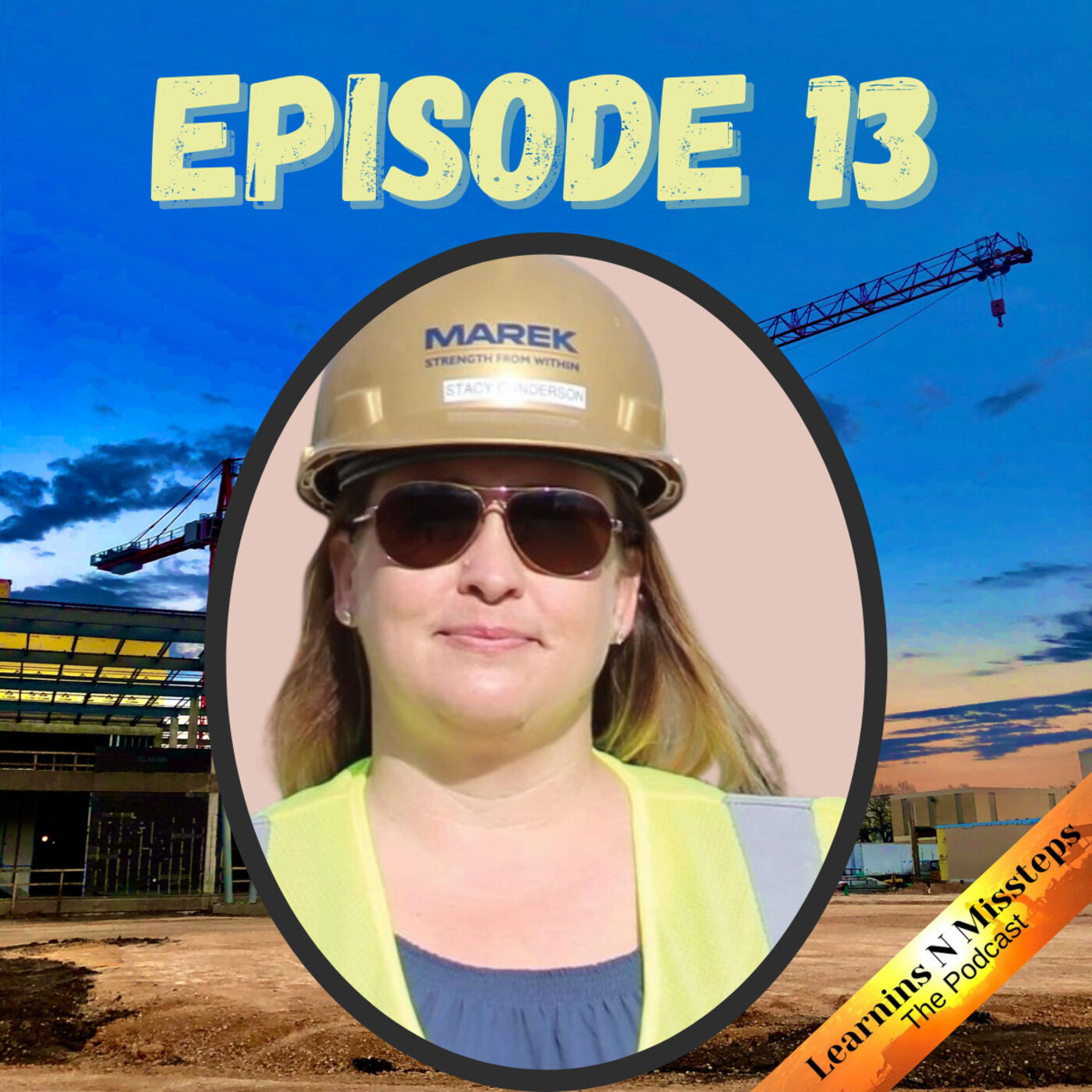
Episode 13: Rockin new Career pathways with Stacy Gunderson

 Apple Podcasts

 Spotify

 Overcast

 Castro

 PocketCasts

 RSS Feed

 Amazon Music

 Audible

 iHeartRadio
This episode covers Stacy's story from "glorified" laborer to Craft Training Superintendent. Jesse and Stacy have an in depth conversation about trade based internships for high school students and the commitment to Workforce Development her organization is displaying. Jesse trys really hard to get Stacy to brag about herself to no avail, but they did get to cover some of the many ways Stacy has impacted the Industry in a big way. Join us in celebrating another Rockstar in the Construction Industry.
Support the cause at:
https://www.patreon.com/learninsnmissteps
Connect with Stacy at:
https://www.linkedin.com/in/stacy-gunderson-67365025/
Connect with us at:
https://www.facebook.com/learninsn.missteps.1/
https://www.instagram.com/learninsnmissteps/?hl=en
https://www.youtube.com/channel/UC4yLjr8swfqCt_vMp74oiXA
https://www.linkedin.com/in/learnins-n-missteps-6525b41b7/
I'm starting to get kind of YouTube snobby because the lighting in this hotel room is horrible.
SPEAKER_00Well, if it doesn't work out, you know, you can always just scrap mine and move on to the next.
SPEAKER_01Negative. You're listening to the Learnins and Missteps podcast, where we intend to change the image of careers in the trades. We celebrate the real men and women who have built careers in the construction industry by bringing their personal stories straight to you. I began my career as a plumber's apprentice in the late 1900s. Over the last 26 years, I've had the fortune of meeting some of the most resilient, intelligent, and inspiring people who happen to be construction workers. My career path as a plumber has provided me with experiences and opportunities I thought were inaccessible. And I want you to know that the trades are a place where dreams can come true. These stories are brought to you by three brothers who share a mother. I am Jesse, your host. Our in-house writer is Ernest, aka La Voz. Hello. And our co-host, Renee. What's up? Y'all ready? Yes, sir. Dale. Jesse here. Some of y'all may have been wondering how do we get more people in the trades? This is a real question a lot of us have on our minds. And there's many uh different initiatives out there. But today you get to hear directly from Miss Stacey Gunderson. Her official title, which I think is the coolest title, is Craft Training Superintendent. She's also a mom and just a straight-up all-around rock star. In this episode, you'll get a whole bunch of the tips and tricks on starting your own internship program, like an internship program for high school students to actually get out there in the field and start discovering all the wondromus things that construction can be. And some direction and advice for career selection. Stacy shares her journey and the various paths that she's taken that got her to where she's at now. Also, Stacy shares exactly what her organization looks for when selecting students for an internship program. And that information may be extremely valuable to you or a loved one and family members. And those of you that are interested in some exclusive content, uh, early access to our episodes and supporting the mission. We set up a Patreon account for y'all to contribute even more than you have so far. We've got four different levels. Uh any level that you sign up for will get you special recognition on the video version of these podcast episodes that we're now releasing on YouTube. We got a YouTube channel, baby. Watch out. We'd love to be able to share your name and let everybody else out there know that that you're behind us. So you can find each of the four levels to sign up and contribute at patreon.com slash learnings and missteps. Uh, we love you guys, and here we go. So, Miss Stacy Gunderson, when I invited you or asked you to be on the podcast, what was your first reaction? Like the words that you didn't want to tell me.
SPEAKER_00Well, that probably wouldn't be PC to say, because as you know me, I'm pretty shy. I mean, for the most part, when you get to know me, you and I will talk and we'll have, you know, a regular conversation. But if you're asking me to like say, hey, what do you do? Do you think it's awesome? Do you whatever? For the most part, I just think I'm doing my job. I don't think it's like outside of the box or awesome or whatever. So it's one of those things where it's like, I love making a difference, but it's like, oh crap, you want me to talk about that? Are you serious?
SPEAKER_01Nice. What are some of those awesome things that people say? Hey, Stacy, we want you to talk about that.
SPEAKER_00It's more so like my experience in workforce development. Um, Merrick's been doing workforce development for 13, 14 years, and I've been involved with it from the inception. I mean, I got to help put the program together. They got a bunch of us SMEs together. We sat down, we created what we wanted to do. It was one of those things we knew training was on the downside. We knew there were a lot of people coming in the door. So we looked outside the box. We're like, let's start a workforce development department, let's start hiring people, let's start seeing that is going to be your bread and butter. That's gonna be your day in, day out. You're gonna be looking to advocate for the industry and bring people in the doors. That was where we roughly started, as far as just sitting down and saying, what do we want to train our people? What are we looking for? How are we gonna do this? And we created a curriculum based off the NCCER platforms.
SPEAKER_01Nice. So Merrick Brothers has a drywall in framing, correct? Right. Commercial. And so y'all have an internal apprenticeship program specific to Merrick Brothers, that correct?
SPEAKER_00We've had a DOL registered as well before we've utilized it. It is approved. We can open it up and utilize it again at any time, but for we are internal.
SPEAKER_01So Department of Labor approved, like you got all the bells and whistles, it's a certified apprenticeship.
SPEAKER_00If we want to go that route, we can if you want to go that route.
SPEAKER_01You know, when I was at TD, I started kind of before I quit them. Uh, I started kind of looking at that DOLT, and then I was like, oh my God, like that's a lot of administrative stuff.
SPEAKER_00I mean a lot, yeah.
SPEAKER_01It's a ton. It's unfortunate because I imagine I'm gonna give maybe some extra credit, undue credit out there, but I imagine other organizations would do it if it wasn't such a heavy lift.
SPEAKER_00They might, yeah. It's definitely a big lift. I mean, you're having to evaluate your people every six months, you're having to sit down and be subjective to the audits and everything that goes along with it. Yeah. Internals our route.
SPEAKER_01Exactly, exactly, right? You produce the product you're looking for. And when I say produce the product, what I mean is is impart those individuals out there with the knowledge base to go out there, perform, and expand their earning capacity.
SPEAKER_02Yeah.
SPEAKER_01Um, how receptive were were your install team to the to that shift way back at the you say, let's say 10 years ago? Were they like, yeah, please sign me up or damn it, I gotta go to class?
SPEAKER_00It was more ours is really heavily based on like the OJL, you know, the the learning side in the field. We do have some supplemental classes, but for the most part, we utilize, you know, the on-the-job training. And in the beginning, it was tough, more so not necessarily with people we were looking to bring in, but internal, like our coaches, trying to get them to understand that hey, this is your partner now, this is who you're going to work with. And it was that mentality almost of, well, nobody taught me, or am I training somebody to take my spot? It's like no, we tried to show them like you know, you train every day regardless. You just don't really realize it. So whenever you're not when you don't have a structured training plan, that training could take like roughly three years. But if you have a structured and you know what you're wanting to teach them, it can take maybe like a year versus the three. So it's like this makes you guys more profitable. It makes you like we're choosing you to be that coach. You shouldn't be looking at it as like, oh man, you should be looking at it as like we're looking to emulate you. We want more people like you. I don't understand why this is so scary.
SPEAKER_01You're the model, bro. Yeah, like no, no. I I you know, it reminds me when I started as a as an apprentice, the very first job I was on, man, and like let me clarify. So I worked with my dad a bunch, and he's a plumber, so he didn't mind telling me how wrongly I was doing things, right? You know, you know that dynamics, like yeah, super awesome dude, but man, if we worked together, it was it was not fun. Anyways, started working with other plumbers in the trade, and they absolutely treated me like I was trying to steal from them. So there's that weird dynamic, like, whoa, wait a minute, like they held a lot of them withheld information, gave me like super menial work to do. It was rare for me to pair up with a plumber that actually would teach me and show me how to do things right and show me the terminology and and all that good stuff. It's an interesting thing. And then similarly at TV, it was like, man, you know, people felt were concerned, they felt a little threatened. It's like, well, you know, teach them what about me? And the reality is is sure I understand the feeling, but if we have more highly skilled individuals, we can get more work. And when we get more work, we need more leaders, we need more superintendents, more foremen, more leadmen, more installers. And what that means is there's more room for you to elevate if you choose to do so. And when I told them that, they're like, Oh, okay. So when am I gonna be superintendent? Like, well, chill out, bro. Like, we're just talking right now.
SPEAKER_00We're going ABC D, not A F.
SPEAKER_01Perfect, yes, exactly. And you said you used the uh NCCER curriculum, but I heard a rumor that you know somebody who wrote the curriculum.
SPEAKER_00NCCER uses SMEs to write their books.
SPEAKER_01Uh-huh.
SPEAKER_00So for drywall curriculum, Merrick was a huge part of that. Now I know what you're alluding to is I helped write one, but that was more on the coaching and mentoring. Uh, they actually utilized our curriculum in a big part of that. So, no, yeah, I've participated as an SME, but for the drywall curriculum, that was new. NCCR didn't have drywall curriculum. And at the time, the director was Katrina Kirsch, and she's real familiar with NCCR, considering she's senior director and COO there now. She left us to go to NCCER formally, officially. But since NCCR didn't have drywall curriculum, we had to get like four other drywall companies to get together and sit down and write drywall level one and two and come up with the test to certify our employees on.
SPEAKER_01So, I mean, you're super humble. I know you, I know you played a big damn role in it. Because like anything you do, girl, you play a huge role. It's not like you just you're present like most committee members and and contributors are like you get down, you you make stuff happen, but you won't take it.
SPEAKER_02Nope, I don't need that credit.
SPEAKER_00I it's just like whatever, I don't need that.
SPEAKER_01But no, so everybody knows Stacy is awesome. So you work for for Merrick Brothers. You're I guess you're is your title now workforce development czar or something like that?
SPEAKER_00No, uh, my official title now is craft training superintendent.
SPEAKER_01Ooh, I like that. That's a that no, that's a cool title. So, how did you get started with Merrick?
SPEAKER_00Uh, it's a long story. Um, I'm what some of us at Merrick call boomerangs, people that go and come back, go and come back. Um my dad is a veteran at Merrick, he's been there over 40 years.
SPEAKER_02Wow.
SPEAKER_00And so I've grown up with Merrick, they're an awesome company. Um, I'm definitely home. But how it started is whenever I was 18, just graduated. My dad was like, hey, you're not gonna spend the summer waiting for school to start. Because at the time I was getting ready to go to dental assisting school. He's like, you're not gonna wait for that. You're gonna see what it is day in and day out. You're gonna see how hard I work. And I think that was one of those I'm gonna scare the cred out of her type of situations where she's gonna understand what I do. I mean, wake up at the time I wake up, go to work, put in the time. Well, it may have backfired a bit because I loved it. It was like he taught us hard work and the ethics of all that, like at a very early age. So we were never afraid to of hard work. So I started as a laborer at 18 and did that over the summer and kind of just got to, you know, get to be familiar with the sights and sounds and all that good stuff and learn the materials and whatnot. Of course, I go off to dental assisting school that doesn't 100% pan out. And then, of course, lo and behold, I get married, I move off, and then it's one of those things where it's like, oh, that marriage didn't work out. I'm getting a divorce, I have a two-year-old with me. What am I gonna do? So it's like, okay, I'm gonna go to school and I'm going to be a teacher. And it's one of those things where it's like, hours seem awesome. I'm gonna be an elementary school teacher. This is gonna be great, but what can I do in the meantime? So I had to ask my dad again. I was like, look, I'm looking to go to school. I want a job where I can work Monday through Friday, and that way I can spend plenty of time with my son, but also have plenty of time to go after school, take online classes. I wanted a set schedule, and you really can't do that with like retail or fast food or whatever. So I was like, I needed structure. So it was like, okay. I was like, do you think I can get another job at Merrick again as a laborer or something? And he's like, I don't really know. I really don't want to do that. And I was like, please, I said, I promise you're not gonna regret it. Just let me come on. I'll I'll do the work, I'll be there. I just need this.
SPEAKER_02Yeah.
SPEAKER_00So he was like, All right, fine, we'll go ahead and we'll put you back out there. So I was, I was working as a laborer and I was going to school in the evenings and had plenty of time to do everything that I needed to do. Well, fast forward that three years, and that's when they started talking about bringing workforce development to the table. By this time I'd already done my student teaching, I was like, hell no, am I gonna be an elementary school teacher? The things that those kids say, there's no way I could do this on the day in and day out. Oh man. Well, they started talking about workforce development, and I was like, that sounds cool. That sounds really cool. That sounds, you know, like perfect almost. So I started paying attention, and of course, I've already remarried at this point. I'm actually getting ready to have another baby. I'm having a little girl at this time. Here we are, and it's it's October, October 2007, and they're talking about okay, hey, what we're gonna do is we're hiring somebody for workforce development. Well, I'd already been out, and so Friday I had my little girl. Tuesday morning, I was at the office meeting Katrina Kirsch, telling her that job is mine. You're not giving anybody else that role. I am going to be your workforce development. At the time, I think I what was it? A workforce development training coordinator. That was my initial title. And of course, at that time, workforce development was a new term for everybody. It was a new term for us. Everybody was like, I can't believe we're doing this. First it was safety. Now this, I don't really want to do this either.
SPEAKER_01Yep. So when you were out there, those those three and a half years with the break in there somewhere, working as a laborer, what was that like?
SPEAKER_00It was awesome.
SPEAKER_01Yeah.
SPEAKER_00Um, yeah, I I loved it. And I call it a labor, but at the same time, I was a laborer, but then I was learning other facets of it. I called it a glorified labor because I did a whole lot more. I did, I learned, of course, the materials and just being around it for as long as I've been around it my entire life. I could kind of I knew the process. It wasn't necessarily like I could pick up a screw gun and and knock it out as fast as they could, but I knew the process of everything. So then it was like I started helping the foreman out. It was like, hey, do you want me to start turning in time? And he's like, Yeah, here, start doing time. And then it was like, Hey, do you want me to send in those RFIs? So I'd start to get to know the RFI process. And then, of course, I started doing layout by learning the dumb end of the tape, holding the dumb end of the tape, you know. So then I got to start figuring it out and reading the prints. And then lo and behold, it was like the foreman had to leave, and he was like, You know the prints, you know the rooms. Um, call me if you need me. I need to go start this other job. And I was like, What? I'm a laborer. You just left me with a crew of five, and I'm here by myself. This is not cool.
SPEAKER_01We trusted you.
SPEAKER_00Yeah, I guess so. It was funny because the guys at the warehouse, they always tease me. They said, As soon as you get a packet on Friday, you're a foreman. I was like, I am not a foreman, nor will I ever be a foreman. So, as a joke, they put my name on a folder and dropped off some stuff to that job site so they could say I was a foreman. Now you're a foreman. I was like, you have way too much time on your hand if you're going out of your way to drop off some bullshit folder.
SPEAKER_01That's odd. But it sounds like the guys, the the guys out there really took to you.
SPEAKER_00I think so. I mean, I love some of them, dear. I mean, I love all of our guys in the field. And but some of them, yeah, if we have a good relationship with, I mean, that's hilarious. When I started with my dad when I was 18, like one of our foremen now, at the time he was a laborer and he was my labor foreman. So now he's like he's running work and he has crews of his own. So I got to see a lot of our foreman who are existing foremen are now. I got to see them years ago and know where they started. America has a lot of tenure, so they stay. It's very much so a family. Whenever you ask somebody how long they've been there, it's not uncommon to hear 10, 15, 20, 25. You're almost still considered a baby at five years.
SPEAKER_01Wow. That is amazing. I mean, that speaks to the culture and the people, the leadership there to create that type of environment. Because I mean, you and I both know in the trades, there's a lot of organizations, a lot of people out there that they jump quick, right? For 50 cents or a dollar, the leaders of those organizations feel like, well, people just don't care anymore. It's like, no, they don't feel cared for.
SPEAKER_00Right.
SPEAKER_01And they're gonna go somewhere they feel appreciated.
SPEAKER_00Money's a big deal, but it is, but a thank you and great job goes a long way too.
SPEAKER_01Oh my goodness, so far. So, so far. Uh now, when you were out there as as a labor or foreman, because you did receive a packet, so that makes it official.
SPEAKER_00Whatever, yeah. Labor, let's go with that. Yeah.
SPEAKER_01Was it rare to see other women out in the field?
SPEAKER_00Then, yes, it's awesome to see it now. It's awesome to see how much it's changed and progressed. I mean, I know I could walk out there before and I'd be the only one. So everybody wanted to talk to you.
SPEAKER_02Of course.
SPEAKER_00Then there'd be somebody else coming in. Like at the most, there was maybe three of us on a job between all the trades.
SPEAKER_01All the trades out of like 80 people, there's three women.
SPEAKER_00Right. I mean, one of the projects on was USAA, so it was huge. And there was three women, one with me being in the drywall, one electrical, and one was doing glory. And now it's like you go everywhere, and I I I like to see it. It's it's cool that it's kind of expanding, and you're going there. It's like cool. It's not just so we've changed a little bit of what we say. We don't say craftsmen anymore, we say our our craftspeople.
SPEAKER_02Okay.
SPEAKER_00Or we'll say our craftsmen and women. We're trying, they're trying to really be inclusive on all of that. And even at work, we have a in our Houston location, because our Houston location definitely has a whole lot more females. So we even have a women at Merrick like support group. Oh, where they get beautiful, yeah. Yeah, where they get together. There's actually like female mentors, like female superintendents in foreman, kind of guiding them along and letting them know, hey, this is me. I understand where you were, this is what can happen, this is how you can progress. Let's all be here to support one another. And so it's it's really neat to see how it shifted.
SPEAKER_01That's amazing. So you brought up a point. I had this question in my mind, or maybe an observation that I've I've made after speaking to several women in construction and in leadership. And so I've I'll it's what I'm always curious about is like also like just like you talked about, there's a mentorship, a mentorship program for the ladies in the business. And it feels like more often than not, when I ask a woman about mentoring other women, their response to me is well, I don't really do that. I struggle with with connecting and mentoring other women. Does that sound familiar at all to you?
SPEAKER_00I can't speak to it personally because, like I said, that's at the Houston location. Um but for myself, no, I mean, even with the American Heart Association, we deal with them a lot. We're one of their sponsors for the Heart Walking, and they're looking to do a female mentorship. And it's more so with like high school age children to kind of give them an idea of where they want to go and non-traditional roles that women are in. And I think it's great. I signed up, and you know me, I'm shy.
SPEAKER_01Yeah. Oh, yeah. I you say you're shy, but I think you know, uh I've let me say it. It's I think this is probably more accurate. I think you are shy, right? If at heart, you would rather be kind of behind the scenes and just let me do my work. Yeah, but you have this amazing talent and compassion for people, and you want to help make things. Better. And you want to make them better far more than you want to be comfortable behind the scenes. So that always pulls you to be the face of the committee or the face of the organization.
SPEAKER_00Sounds like pretty accurate. I mean, for the most part, it's one of those things. I'm shy till you get to know me. You know, I can be one of the most outgoing, crazy people at the same time. But if you're going to get me to sit down one-on-one and like brag on myself or talk about what I do, it's like, no, no. What about that person over there? Can we bring them in? I don't even know that guy. Well, let's get to know them.
SPEAKER_01Let's go meet them.
SPEAKER_00Let's deflect. Let's go somewhere else.
SPEAKER_01That's so awesome. But you know, that's that's super refreshing because there's too many people out there that want to say me, me, me, me, right? Like they haven't we're involved in a lot of committees, right? In a lot of groups and organizations that want to do something to improve the situation. And a lot of people want to have their name associated with it. And they want to do the talking, but they don't want to do the working. Have you seen that?
SPEAKER_02No, not on any of the never.
SPEAKER_01And so to have somebody that says, yeah, give me the work, I got that, I'll make that happen. And I don't care about the credit and and uh the run, right? Like getting out there in front of the community for people to recognize me in my organization. That's refreshing. That's super. I mean, that's part of the reason why I love working with you because make things happen. What do you want our listeners, our audience to know about you?
SPEAKER_00Nothing.
SPEAKER_01Nothing.
SPEAKER_00That is the best answer I've heard ever. Oh no, I don't know, Jesse. It's one of those things. It's like if you know how passionate I am about workforce and helping other people grow, I mean, I have been afforded a huge opportunity at Merrick. It's like they've never limited me on my growth, they've always encouraged me and I'd like to kind of return that favor. And anybody who's willing to put in the work and the time that's involved with it, because nobody's gonna hand it to you. You do have to work for it. And if anybody knew anything about me, it's one of those things where I'll help you do whatever the hell you'd want to do, I'll help you get to wherever you need to go, but I'm not gonna do it for you. Yeah, I'll hold your hand, I'll guide you, I'll encourage you. But at the end of the day, that heavy lift has to be you. You have to want it. You can't just say you want it, right? You have to do it, and you're gonna have to put play an integral part in it. So if anybody knew anything else about me as well, frustrating as it is, if you're the same person coming to me saying, I want help, I want help, I want help, but you're not doing it, eventually I'm gonna be like, seriously, we've had this conversation.
SPEAKER_01Yeah, no, we've talked about this 10 times and it you're still not doing what we talked about.
SPEAKER_00You stepped in step one, so right.
SPEAKER_01Well, accountability is important, uh, and enabling is not a good thing. And I don't think I could I would never classify you as an enabler.
SPEAKER_00It's funny, we just took this test at work, and it was one of those things where it told you what you were good at. And I one of mine came out as and I thought it was a terrible thing because it said enabler. I I was tenacity, which I got that, yeah, totally understood that. I was like, Yeah, get it, rock that one. And the other one was enabler. And I was like, I don't like that term, but when I read what it meant to be an enabler, it's it meant like you were the encourager, you were the cheerleader, you wanted to see people grow, and you would, I was like, okay, can we change that to like ambassador or something else? But can we get rid of that term enabler? Because I automatically was just like, no, that's that's not me. I I'm I'm not that no scratch, start over. I even asked my supervisor. I asked her, I was like, can I take the test again until I get the results that I want to get? She started laughing. She goes, You're funny. Watch the videos, make sure you understand it 100%, and then go from there. So whenever the team had to share what they were, it was funny to hear like the other enablers were like, No, I hate that term. I'm not an enabler.
SPEAKER_01Yep, yep.
SPEAKER_00But whenever you realize what it actually truly meant, everybody was like, Okay, yeah, that's me. You can go ahead and put me in that box. I'm okay to be there now.
SPEAKER_01I I'll I agree with you. There is a better word, maybe advocate or something. You do unlock people's potential, right? That's what you that's one of the many uh superpowers that you have is to be able to for me, I'll speak specifically, like being around you on the different things that we've worked on. It the way you carry yourself, the way you speak, the way you handle things, make me say, ah, okay, I can do that. And also I need to do that because Stacy's knocking it out. Like I gotta, I gotta step up, and most of the time you're doing most of the damn work. So it's like, geez, I come on, I need to at least put my plates in the in the sink. You know, I can't just sit here and eat. So yeah, I mean, maybe the word's not the greatest, but the the impact and effect that you have on people is accurate. Uh that that's funny. Can I take the test until I get the answer I want?
SPEAKER_00She told me no, she's awesome.
SPEAKER_01Is this uh sable?
SPEAKER_00Sabra, yeah.
SPEAKER_01Sabra, sabra.
SPEAKER_00Yeah.
SPEAKER_01Oh yeah, she is awesome. Y'all are both pretty darn awesome. Man, y'all have some awesome people over there.
SPEAKER_00We do, we definitely do. We have an awesome talent team now. It's really exciting because for me, I was, you know, my whole time of workforce development, I was San Antonio all the way up until last year when Sabra was like, Hey, do you want to come over to the corporate team? Make you craft training superintendent, and you're gonna oversee four branches and their training programs. We want to get results. We want to like drive down and kind of really format this. So the workforce development or the talent team, I should say, has grown immensely in the past year. We have two craft training superintendents now, and we have a lead for helping develop the curriculum and whatnot. And they have two people that help develop content. And I mean, it's our team group went from like three to like seven.
SPEAKER_01Nice.
SPEAKER_00And Sabra's ahead of all of us, so it's one of those things that she's high energy, very impactful, and she's she's very results driven, and it's it's it's cool, and she pushes, she pushes. So I will learn a great deal from her. So that part's gonna be I suck it up as much as I can. It's like, oh, that was good. Let me let me write that down. Let me see if I can use that somewhere.
SPEAKER_01Yes, I'm gonna I'm gonna go practice that. Let me add it to my toolbox. This talent development team, uh, how many of those team members are like have real field experience? I mean, I know obviously you do.
SPEAKER_00Uh, two of us. The the craft training superintendents, we have the the field experience, and then of course we advocate for our teams, and then then we go back over and say, okay, this is what we want to develop for learning, and then we get SMEs in the field to work with those partners.
SPEAKER_02Okay.
SPEAKER_00And they develop based off what we're what we're working to put together.
SPEAKER_01That's beautiful. That's I mean, that's the only way to do it, right? Like have people dedicated to that task because it's not like a side job, right? It's not like uh, hey, can you also do this? It's real work. Yeah. And so you need people offline to do that work, but also need to have the foresight to say, hey, let's go ask the experts, the subject matter experts that do this every single day to see, like, is this even like is it practical? Uh it sounds like y'all are doing that.
SPEAKER_00Man, yeah, we have SMEs doing, of course, the lifting on like helping develop the content, but we have the other side of it where they're like the main organizers and the ones who are really dynamic and good at putting curriculum together and putting the graphics together behind it. It's creating that relationship to like one can't do it without the other. So it's we're working to do to get that all paired perfectly.
SPEAKER_01Yes, getting the right skill sets together. Man, you're pretty smart people over there. We try. Think back to like middle school, now even maybe high school. What were your earliest career aspirations?
SPEAKER_00Well, it's funny because I think a lot of this has to do with growing up in a small town that you don't see a whole lot of different opportunities, I guess you could say.
unknownOkay.
SPEAKER_00I was always at the dentist. So I wanted to be an orthodontist forever, from elementary all the way through high school. I was like, yep, I'm gonna be an orthodontist. Obviously, that didn't work out because I went to I my orthodontist told me, hey, go to dental assisting school, it'll help you get through school as it is, and then you'll get to kind of get a feel of what it's like working side by side. The mouth is a dirty, dirty, dark place. Yes. So yeah, no, no, it is a dirty, scary, dark place. So obviously, that went right out the window. And then, of course, as you heard, I was like, okay, next I'm gonna be a teacher, and that went out the window. I I am home and I have no regrets.
SPEAKER_01Yes, and the industry's better with you in it, like, no doubt. So, what kind of advice would you give to a student that's thinking about their career? Uh you know, knowing what you know now, you had an idea you wanted to be an orthodontist, and you didn't want to play in dark, dirty mouths, and you you wanted to be an elementary teacher and actually committed some years in time to get those qualifications and discovered, like, uh yeah, maybe not. What would you tell a student that's planning their next four years of their life in terms of studying and what direction they're headed for their career?
SPEAKER_00That's one of the reasons I love our internship program now. Whenever I do talk to these high school students, especially the ones who are involved in the trades, and they want to kind of get a feel for it. It's like, you know, you don't know what you want to do 100% yet. It's like whenever somebody asks you what you want to do when you grow up, like construction is not even on the checklist. Oh, yeah. Any trade. It's like doctor, lawyer. Oh, okay, this is the what I have to choose from. So nobody ever really thinks outside the box as far as construction. They have it as like a extra class, like CTE in in the high schools and whatnot, but you're kind of thinking it's whatever. It's like cool, I didn't have to take a fourth year of math or whatever.
SPEAKER_02Yeah. Yeah.
SPEAKER_00So with the internships now, what's cool about working, like going into a classroom and saying, hey, if you're 16, you're involved in this class, what you can do is we can hire you for the summer and you can try it. You can learn what you've used in the classroom, you could take it out. It's one of those things where it's almost like test driving a car. You can try the career out before you buy it. Let's go ahead and give it a shot and see. And if it's not for you, it's not for you. But I would tell anybody that at this point in time. It's don't be in a rush to make your four-year decision. Speaking for myself, I changed my major like four times before I ever really got to the end. So it's like, don't be afraid to go against the norm. There's nothing wrong with construction, it's a great place to be. Just talk to the individuals out here. You'll see that they're definitely killing it, making the money. It's yeah, it's hard work, but at the same time, if you want to heck, do what I did, even as so as far as like I worked Monday through Friday, 7 to 3:30 for the most part. And I was able to go to school at night, so I didn't have to accumulate all kinds of student loans or anything like that. It was one of those things where you could pay as you play, you know, pay as you go, type of type of situations. I would definitely encourage getting out there and trying something else. And I know it's not like necessarily what the parents per se want to hear.
SPEAKER_02Right.
SPEAKER_00And that's another reason why I love the internship. Everybody's always behind the summer jobs. Like you want to work for the summer, fine, great. That's not gonna be that's not gonna be your career. Go ahead and give that a shot. But then when they their student get their child gets in it, and they're they see them every day, and they're they see the excitement and the change in them, and then it's like, and then they get to know the company and see how much the company cared for them as well. It's like, well, you know what, maybe this isn't such a bad thing for for them after all. It's they're definitely doing their best to keep them safe. They're they're training them, they're teaching them. It's not just, hey, let me give you, you know, the safety orientation and boom, kick you out the door and good luck. It's definitely not that at all. You have to be sure you're following all the rules to make sure they're safe and taken care of and learning at the best environment.
SPEAKER_01So and y'all have the the journeymen, the more experienced folks like dedicated to to support and mentor that student. So they're not just kind of out there, there's somebody that is responsible for that, for their learning and for their safety, most importantly. Can you say can you tell us more about this internship program? Because I know nationally y'all's internship program is significantly different than most construction companies' internship programs. Can you give us any details on that?
SPEAKER_00Well, how is it? Well, can you give me details on how it's different? Well, sure.
SPEAKER_01So I mean, you mentioned, right, 16-year-olds. Yeah. You've got you've got high school students under the age of 18 working on your job site.
SPEAKER_00Yes, correct.
SPEAKER_01How do y'all manage that?
SPEAKER_00How is well you have to look you have to follow, of course, the Department of Labor. And there are stipulations to where 16 can work in the industry. So you have to be very diligent in looking at at all of those rules and qualifications and everything. And they can be involved in construction trades courses, but it does go a little bit further than that. You do have to have a written agreement with the school saying it's conductive to their learning, so or conducive rather to their learning. So right now we have an agreement with Southwest ISD. Nice, and we partnered with their CTE director there, and we have a written agreement. Um, we go in and we train those students on metal studing as well. So they're working to learn it in the classroom even before they go out onto the job sites. So then we go in there, of course, we pick the students that are going to go ahead and that are interested in learning, and then we partner with them and they come work with us for the summer. But even before they can come with us for the summer, we even have like we call it like boot camp, and they have a week long where they're in the office and we're doing the safety, we're getting them immersed in safety training. We do economics of the job so they can understand like the project from start to finish. Then we go through and we show them all the tools and how they work. Then we go and show them all the materials. We teach them how to flip the rock before they go out there and hurt themselves. They have to learn how to carry the stuff correctly. Um, we loan them the tools for the week. So we sit down and we help put their tool pouches together versus left hand versus right hand so that so it makes sense to them. And then we go and we spend time with them working in the warehouse. We'll create like a mock build where they'll get to do some hands-on application before they even go out there. And then the last day we'll take them out onto the job site and do a safety walk. Um, we'll introduce them to the foreman to their coach and we'll give them a tour of the job site. That way they're really comfortable and know exactly where to go when they show up for their first day Monday morning.
SPEAKER_01And so y'all are in your fourth, fifth year of this internship program?
SPEAKER_00I think it'll be a fourth.
SPEAKER_01Fourth. What was it like the first year? What it was specifically for the people in the field. What was their response to the idea?
SPEAKER_00For all of us, it was scary as hell. Yeah. For all of us. Um the response in the field was actually pretty good, except for the fact, like you they can't be on a lift, they can't do this, they can't do that. Even so, I mean, the coaches that we ended up picking, it's funny, we were very picky about the coaches. They had to be, you know, our top journeymen, but at the same time, they had to be people people. They had they had to have a personality, and they had we even tried to pair them with people who had kids so they kind of understood the dynamic of what they were dealing with. And I mean, one of our coaches, he had somebody the exact same age, he had a son the exact same age, but it's funny because this guy's a clown in himself, but he's kind of one of those ones that's funny to be around.
SPEAKER_02Sure.
SPEAKER_00So they all did really well, they loved it. They actually even wanted to go to these kids' high school graduations, but they created a huge relationship. They worked with each other day in and day out, they actually seemed to like really get along really well. Um, we hired our first two interns, of course, it was they were going into their junior year, and then they came back their junior year till their summer year, and they roughly had the same coaches for the most part. They wanted to go to their high school graduations.
SPEAKER_01Oh my god, that's beautiful, really.
SPEAKER_00Yeah, yeah. They wanted, of course, it was COVID, so they didn't even really have a high school graduation, right?
SPEAKER_01Right.
SPEAKER_00So, but yeah, they wanted to go to the high school graduations. They were like, these are some good kids. We're wondering how they're doing and what's going on and where are they at? And so our first year we only had so this will be our third year for San Antonio. Okay, yeah. Houston will be on their second year this year, so we're all taking baby steps. Atlanta might have their very first this year. So it's exciting. Yeah, it's exciting. It is.
SPEAKER_01Oh my goodness.
SPEAKER_00So our first year we had three interns, our second, our sorry, two interns. Our second year we had three, and one of those interns is graduated now and he's here full time.
SPEAKER_01Oh man, that's that's what you want. That's exactly what we want. And he made the choice, it sounds like, right? Like this is what I want to do. Oh man, that is so we need to we need to get him on the show. Uh, or maybe, maybe like a group of them together. Um so you know, we I I played around with the internship thing at T V also, right? And and there, yeah, I I didn't know the rules, and and maybe I didn't want to know all the rules purposely, right? I don't know.
SPEAKER_00There's a lot of rules.
SPEAKER_01There's a ton of rules. But I did discover um a problem that we just kind of it didn't become a problem because we didn't announce the situation. But since then, there's you know, you you started your internship program, other organizations. It feels like San Antonio, boom, there was a group of people and they're right starting to do it and they're making it happen. But here's the problem that I think still exists is our general contractors. What can our general contractors do to make it easier to bring to grow internship programs for trade contractors?
SPEAKER_00It's a good question. I don't know what they could do to make it easier because some of our GCs were kind of interested in doing their own after learning about it a little bit. And then, of course, once we told them about it a little bit more, they're like, Well, I want to learn more. So, as you know, we asked our general contractors before we went out there, made sure they were aware. Now we have like this whole internship toolkit that we've been working on as far as like what do you need to do? What are the steps? And it's kind of like, okay, 16 weeks out, you need to be doing X. And then at this point, you need to be talking to the general contractors. It was one of those things we didn't really want to put together, but there was such a need to put it together, especially for somebody who's never done it before. So, like, say Atlanta, they're getting ready to do theirs, so they'll have something to follow as far as like A, B, C, D, you know, this is what I need to do, step one, step two. So we have a letter that goes out to our general contractors from the owner saying, like, this is what we need to do, this is why we need to do it. We're being very responsible about it. And then we have another letter that goes just to the risk management team for the DCs.
SPEAKER_02That's important.
SPEAKER_00It's like, okay, we're not giving you the hoop law as to like why this is important, why we should do this. You want to know, can we do it legally? What are the stipulations behind it? So we have another one for them specifically that ties back to okay, these are the DOL laws. This is the written agreement we have with the schools, this is what we have. We have put everything that we need and then attach it to that piece so they can see it's that's definitely not what we did. T D wasn't necessarily what we did the first time, but Houston has a really huge internship. Theirs is dynamic, so we learned a lot from theirs getting into it because they partnered with Houston ISD and HCC. So they have students who go to school for their regular core classes, but then in the afternoon they spend time just learning drywall. So it's truly a drywall apprenticeship. They have a pipeline that they're that they're growing. It's like CCA, but not. Did you have that in school growing up where you could do your classes? At this point, but then the rest of the afternoon, at your junior and senior year, you got to focus on, like, say, automotive or construction or anything like that.
SPEAKER_01They had, I think, ours specifically at the best high school in the nation, Bracken Ridge, Eagles. Um, it was there was like a nursing program, it was HOSA, I think. And there was another program where people could go to school in the morning and then they worked in the afternoon, like a co-op. I don't remember what the official language was, but there were a lot of people that got to do that. Uh, and it counted towards their it was associated with the school. Man, that's important. We I'm hoping that that continues to grow. Now, when you're selecting students, what characteristics in a student are you looking for?
SPEAKER_00It's funny, whenever we do these interviews, or a lot of times it's like a small job fair for the internship, like you know how we did at UTSA.
SPEAKER_01Oh, yeah.
SPEAKER_00Personality really goes a long way. That's one of them, of course. When you kind of talk to somebody and you know they're outgoing and and willing to give it a shot, you can kind of see like you kind of know who your 110% people are by the way they they talk. But I look, of course, at that. I look at um, of course, their transportation can they easily get from point A to point B because you know San Antonio and job sites are like extremely spread out. They're never there's hardly ever a bus route that can do it, or or at least mom and dad can get them there, seeing how reliable that is. Of course, we do the drug testing, so that's key.
SPEAKER_02Yep.
SPEAKER_00And then um what they've learned in class. And I'll even ask their instructor like what type of learner they are, and if they're like necessarily, I guess you could quote like the trouble kid, that doesn't, you know, exclude them from anything at all, because sometimes it's boredom. So it's one of those things that they're it's you know, math, English, science, they that might not be their their thing. They want to be with their hands, so it's I don't like it whenever somebody says, Oh, we're only taking the good kids on on the field trip or whatever. It's like, no, why?
SPEAKER_01Right, right. Like those other kids, they need that. So, you know what what I really love that you just said, or maybe that you didn't say, you didn't say you look at their grades.
SPEAKER_00No, gosh, no. I mean, they have to be passing, of course. I but they don't have to be like the straight A student by any means. No, book smarts doesn't equate to common sense, especially on when it comes to a job site.
SPEAKER_01Oh my god, you you just said it. I mean, that's it. Thinking back when I was in school, school was so easy that it was boring. But when I got into something that that engaged my hands and that I could be physically involved with, I was gold. Like I could behave for that period of time. But if I didn't have that, my goodness, it's like you want me to do homework? I already know how to do that. Why am I gonna practice that? I know it. It was so my grades didn't my grades weren't the greatest. Class was easy, and I didn't really care about grades so much.
SPEAKER_02Right.
SPEAKER_01Uh, you know, I had a lot of friends, they were they're very intellectual, very smart, and grades were very important things to them in their life. And I, you know, I heard everybody tell me how important they were. I just never figured it out. I never could appreciate that. And anyway, so fast forward when when we were when we started recruiting high school students, it was interesting that the teachers would bring their straight A students, right? The the those kids. And awesome, right? Thank you. Because those kids are are fantastic, they can perform, they follow direction. However, the first early round before we started the internship program, some of those straight A students they struggled in the field with like the simple application of things. And and it it almost seemed like the students that weren't the straight A students, like they could just figure it out. They would just figure it out, right? And I know that's horrible to say, well, here I need you to do this and figure it out without much direction, but it was almost like the higher their GPA, the more instruction and explicit direction they needed, as opposed to the lower the GPA. It was like, hey man, we need to do X, Y, and Z. And before you turn around, like they're done. Like, dude, how'd you do that? Well, I just I just did did it, you know, like, okay, good job. Did I do it right? Like, I don't know if you did it right, but you got the outcome we're looking for, and that's the point.
SPEAKER_00Yeah, it's it's funny. It's like math class versus the construction math class. It's like totally different concepts, but the problems are essentially the same. They're just put into a real world scenario, and it's like, especially when it comes to fractions, we deal with fractions all day long, and somebody's like, Oh, I'm not good in math, but you just knock that out.
SPEAKER_01Right.
SPEAKER_00That was math all day long that you just did. You're awesome in math, you're just not really thinking about it. You're just you're reacting, you're not freaking out over what it looks like on front of you on a piece of paper, or you know it's it's on a piece of paper, but it's gonna tie to my GPA, and I have to pass this test in order to get through to the next level or whatever. It's totally different.
SPEAKER_01Yes, yeah, and it's the direct application of it, right? I I mean, I remember I had to go back and apologize to my calculus teacher in high school because one day I was being a little smarty pants. I told her, I was like, who nobody needs to know calculus? Like the only people that need to know calculus are calculus teachers. So what's the big deal, right? Then I went and started my plumbing apprenticeship, and I think I was second or third year apprentice, and we're looking at sizing holding tanks and thermodynamics and stuff like this. That's kind of crap. Yes, exactly. So I had to go back to Ms. Patterson. Ms. Patterson, I'm sorry, calculus is important. I just learned that as a plumbing apprentice, like I couldn't understand what the reason or purpose for it was until I actually saw the application of it. And then it made then it cleared it up. Like, damn it, I wish we'd have done this in school because then I would have cared, maybe.
SPEAKER_00Tie it to money, tie it to real world, just tie it to something.
SPEAKER_01Yeah, we're talking about these theories and myths. Like, I'd rather be in Greek mythology if that's all we're gonna talk about. It's concepts. Super happy you've got your internship program going on. It's spread into Houston, it's going to Atlanta. Like we that fire cannot burn fast enough, right?
SPEAKER_00Well, Houston's, like I said, theirs is on the next level. So I'm hoping that we can emulate Houston's in other locations, how they're tying with like the school districts and how they're partnering with the local community college to take it to bam bam the next level. Yeah, yeah. I would like to see them grow like that.
SPEAKER_02Yes.
SPEAKER_00That's insane. Yeah, I mean, I have a teacher story for you.
SPEAKER_02Ooh, give it to me.
SPEAKER_00Mine is mine's like when I was in middle school and the teacher was upset with all of us. I guess we were misbehaving, and it was an English class, and she was like, What do y'all? She was like, Y'all all need to pay attention. What do y'all want to be a bunch of construction workers for the rest of your life? And it was like, everybody was like, ooh, because of course they knew my dad was in construction, and it was one of those things where, and of course, I've never apologized to this woman, nor will I ever. But I stood up and it was the only time I ever really got in trouble in school because I stood up and I was like, My father is in construction, and I bet he makes 10 times the amount you do right now. Ooh, gangster, no way. I never I I'm not that type of person, but it was one of those things. What's wrong with construction? Why do we have to look at it like that? Why is it something that is beneath? It's like if it wasn't for the construction worker, you wouldn't have the classroom you're standing in, or the hospital you're having to take your family to, or you know, the college where you're gonna send your kids to be better than that construction worker.
SPEAKER_01So what grade was an a-hole?
SPEAKER_00Get him. I was in seven.
SPEAKER_01Oh, so you were young. That was a big deal.
SPEAKER_00Yeah.
SPEAKER_01So is that when when you discovered that you had to be a public speaker?
SPEAKER_00Oh, no, probably definitely not. Public speaking still, I think I'd break out into hives.
SPEAKER_01But you've you've you get tapped on the shoulder quite a bit to to do some speaking, don't you?
SPEAKER_00Sometimes more than I care for. It's one of those things. It's not that I can't do it. It I just I definitely don't get any, you know, I don't thrive on it. I don't, it's not one of those things where I'm like, yeah, I was asked to, and I can't wait. No, it's more like dread. Oh and it's funny because like Sabra, my boss, I mean, she's she knew that about me. And we're getting ready to, and she asked me to go to Long Beach a couple years ago to see the NCC convention and whatnot. And commercial drywall is not a part of the NCC, or at least it wasn't at the time.
SPEAKER_02Yeah.
SPEAKER_00And then we're there and we're meeting with some drywall peer groups and we're seeing if they're gonna be interested. And then she kind of leans over and she was like, You know why you're here, right? I was like, We're looking to start, you know, NCC drywall competition. She was like, Yeah, and you're looking into all this. She goes, with TCCI and all that stuff. She goes, I know you can plan things, so this is going to be your buddy, this is gonna be your baby. So it's one of those things where I had to go outside of my comfort zone and I had to call all these leaders from all these different drywall companies from all over the United States, see if they were interested. So we got to do a pilot of the NCC competition. And of course, Merrick was involved along with a few other companies last year. Let's see, we're in 21 now. 2020 was supposed to be our very first competition. Of course, it got canceled due to COVID and so did 21. But we're looking to bring it back. We're still, you know, involved with those companies and trying to, you know, garner that interest and make sure they're still on the hook to get us at least five. I mean, our first year out, we were gonna have 10 companies involved.
SPEAKER_01Ooh, that's big.
SPEAKER_00Yeah, and they were like, if you don't make it within your first two years, it tends to fall off and not be involved with the NCC anymore. It's kind of cool though, because we're doing these internal competitions in the company. So we're, you know, we're picking, yeah, we're picking like, okay, who's gonna be our competitors? Of course, we didn't know COVID was gonna happen. So we had our people ready to go to Nashville, and of course, they didn't get to go to Nashville. It was like, okay, let's keep going, let's hope for the best. And the next one was supposed to be in Dallas. So we identified our people, and it's like San Antonio has a all our branch locations have their own competition. And then what we do is we take those winners from each of those and we have them compete against the company. So it's like, okay, there's only one merit person going. So who's gonna be who's gonna represent? So it's like San Antonio going against Houston, against Dallas, against Atlanta, and it's one of those fun internal competitions where everybody's like, it's gonna be my branch, we're gonna be the ones to represent the company, and everybody's like, no, it's gonna be me, it's gonna be mine. Yeah, so that that's fun, that's good stuff.
SPEAKER_01So NCC, what does that stand for?
SPEAKER_00Uh, National Craft Champions.
SPEAKER_01And you've mentioned almost like Rockstar. And on that note, rock stars and other acronyms, TCCI, you've mentioned TCCI a few times. Can you tell us more about that?
SPEAKER_00Texas Construction Career Initiative. That was what was started years ago to help gauge the interest of high school students entering the construction field. And it's a really cool event in the sense that, okay, yeah, you we're getting almost a thousand students together. But the beautiful part is it's getting all the trades together for a common interest. Um, you're gonna have like seven different electrical companies there, you're gonna have five different, you know, mechanical, you have a few different drywall, but you're all there for the common goal. You're there to one, see what the new talent is, but two, you're advocating for your industry and talking about there's a place for you, there's a career opportunity, there's room for you to grow. It's almost like you don't care where they go as long as you you know they're in the industry. Everybody's supporting each other. It's not like mine, I talked to that student, I want them. It's like you got them over there, okay, cool. At least they're in. Everybody just has the same outcome. They want to educate the individuals coming in. And of course, you know, we have that student build portion of it. And yes, that ended up being huge. I didn't think it would be as big as it is. Everybody really likes to turn around and see what the students are cranking out, and they didn't the perception is this age group doesn't want to work, but then you turned around and you see them knocking it out and competing and you see what they're learning on a day in and day out. It's almost an aha moment on both sides. And that's what I really, really love. It's like they're like, Yeah, I'll go. I don't know how many students we're we're gonna get, but at the same time, they don't know what they're learning on a day in and day out, and maybe they're gonna partner now and spend some more time with those individuals at that school. So it's it's really about all kinds of relationships that are done that day. It's one of those ones I love, but I love to hate it at the same time because it is a huge undertaking as well.
SPEAKER_01Because you've kind of been the brains and the muscle behind that whole thing year after year.
SPEAKER_00Yep, time to pass the torch. Oh my goodness, I'm scared.
SPEAKER_01You know, when the first, I don't know, yeah, it was the first time that I went to that for to the event here in San Antonio, and like you say, it was if not, it was easily a thousand students, like all from all around Region 20 in Texas. Bust them in, they came, they interacted. We had a booth, right? We were selling, you know, come work at TD. And I got to watch this the build competition. And that's where, like, I said, okay, we can do something differently here because I got to see them applying the skills, safety, planning, communication, teamwork, and doing the damn work, right? They built the little cube, the two walls, they roughed in the electrical, they built the framing, they put the sheetrock on it, did some plumbing fixtures. You know, different teams were able to accomplish more than others. Right. But without a doubt, I got to see all of these students actually doing it and and killing it. You know, sitting there watching them, thinking like, this is interesting. You know, I'm on workforce development committees in the industry or at that time, and everybody's biggest pain point is we don't have enough students being interested in the trades coming into construction. And then, you know, also being involved with uh advisory councils for local high schools that have CTE programs, and their biggest pain point was well, we we're teaching all of this, but the kids end up if they don't go to college, we don't know what they do, but we definitely know that they're not going into industry, into the construction industry. And I'm like, this is pretty dumb, right? Like why? What's going on? What the hell is going on here? You're come. I'm over here with you know, the contractors complaining about we don't have enough kids. We got these programs in high schools pushing out, I mean, producing kids with skills. Don't get me wrong, they're not gonna come in and run your business, but they're coming in with OSHA 10 in some cases, right? They've got an OSHA 10 certification, they have a fundamental knowledge of tools and material, uh, safety.
SPEAKER_00Most of them now are coming in with drywall core from NCCER.
SPEAKER_01There you go. They're coming out with real industry knowledge, and what we're doing within the companies is we're fighting over the same group of people, paying them just a little bit more every cycle they make it through, right? Before they go to the next company. Or we're paying, you know, bring the recruiting at that time was like, okay, well, it's we need people, so it's somebody's cousin or friend or whatever, which is great. We need them too. But we're paying them a wage and they don't have that fundamental knowledge. And and not only that, you know, once they started the internship program there at TD, the the amazing discovery that I could not have anticipated was, you know, yes, we're paying the kids a lot of money. I mean, one of the principals actually brought it up to me, like, Jess, like, hold on, because that amount of money may cause the kid to choose not to come back and finish high school.
SPEAKER_00We got that too, yeah.
SPEAKER_01Right. And I never even thought about that. I said, Oh, so we had to go back and edit and write into the program, like you will not be in the program if you don't complete high school.
SPEAKER_02Right.
SPEAKER_01So that they wouldn't drop out. Like, I never, like, duh, that's a real life thing, right? Because you know, some people are struggling out there, and that extra income makes a big difference. But here's what I saw that just I said, okay, this is it, we got to keep doing it. Is the high school student that came to work for the summer that was making, like you said, they're working 7 to 3:30, reliable schedule, Monday through Friday, maybe some overtime, uh, which was a rule that I learned. I don't want to push overtime on them. Um yeah. And but the amount of money that they were making was enormous to them. So they're 18, right? They don't have any debt, they don't have any kids, they don't have a house and a car payment. Like, so the amount of money was a large amount of money, but for them was like even bigger because it was just free money to them compared to the 20, 21-year-old that we're recruiting who has a kid, who's got a car payment, who has an apartment. So that same amount of money just isn't enough. So, what's the big deal? Well, the big deal is the student that didn't have all that external pressure was more motivated to learn and and thrive in an environment than the other because they just because of the the external stressors they weren't dealing with. Huge, huge difference. They learned and applied and asked questions and and it was beautiful. So, point the whole point is we gotta connect them, right? And and that's starting to happen, but it's not happening. And for me, it's not happening fast enough. We all had this epiphany, like, oh my goodness, we can get these 16-year-olds out there if we put some measures in place to keep them protected. And and you have a playbook now, obviously. There's other organizations in San Antonio doing it, but it's not everyone. And then if we think outside of San Antonio tightly, you know, if we keep zooming out, the percentage of of contractors that are actually doing something to get students into the industry and transition them appropriately, is it's small, super small.
SPEAKER_00So and now's the time to be striking.
SPEAKER_01How do you mean?
SPEAKER_00Well, like say Merrick, for example, started workforce development 13 years ago, relatively new term. You had to fight uphill battles just to get involved with the schools. Switch that to now. Now schools are contacting you saying, hey, I hear you have this thing. It's like everybody is finally speaking the same language. I mean, I'm sure you've noticed it. It's like it's been a whole, you know, it's flipped the script. It's like it's almost cool we started when we did, because now it's like, okay, we've adapted, we've we've made our mistakes, we've learned, we've got the program like exactly where we want it. Of course, just you know, continue to build upon it and to have it grow. But for the most part, it's one of those things. It's like now everybody's coming to the table. Now workforce development is something that the schools are even talking about, and they're they're looking for places for their students to go versus us looking like, please let us come talk to your class. It's like, well, I think we could fit you in on this day. Now it's like, when do you want to come? One time, five, ten? You want to come every week? Cool. It's yes, it's totally switched now. And it's it's really cool to see. Now's the time to strike. Now everybody needs to be speaking that same language and get on the ball with talent and creating this new pipeline and getting individuals excited and educating them about the opportunities that exist because a lot of people still just don't realize they're there, and schools still focus heavily on residential versus commercial. And there's so many more opportunities. I mean, there's nothing wrong with residential at all, but there's so many more opportunities in commercial.
SPEAKER_01Yeah, in terms of career trajectory, without a doubt. I mean, hell, you and I are examples of that, right? Like I started as a laborer too.
SPEAKER_02Yep.
SPEAKER_01Uh, you know, here's here's gonna be my I'll know that it's happening to the degree that I that it should be happening when the construction worker that goes to speak at career day doesn't end up getting bumped down to kindergarten and first grade. So there's a little bit of resentment with that, right? I've I've done several career day uh things and I love it. Like I don't care what grade they're in because please get me with the first graders because that's about my maturity level, right? So I can connect with them. But there's many, many almost I can only think of one time where I I ended up speaking with the with the initial grade that I was paired up with. Every other time it was like, okay, you're gonna talk to eighth graders. Well, hey, we had a little bit of a change, sixth graders. I you know, something came up. Are you okay with third grade? Like and I kept getting downgraded. And what I discovered was because as this the thing was planning, they found the more traditional, sexier type of careers. Yeah. And and so they wanted to put those in front of those two. And hey, cool, right? Do that. Um, but again, we'll know for me when we have arrived when the construction professionals don't get bumped down, right? Or more even better, where we have so many construction workers that we have one for every single grade level speaking at career, right? Like that's that's where we need to get. Okay, so I'm gonna switch it up a little bit. Thank you for sharing. I imagine that people are probably gonna be reaching out and wanting more information on on the internship program. I hope so, because it's powerful. As we go through the life of Stacy Gunderson, the young the child that was two years old, I think when you went back to to Merrick to start working, he's he's now in the military.
SPEAKER_00Yep.
SPEAKER_01What was that like?
SPEAKER_00Well, it was cool because he is he was a student at CCA. So he he did go the construction route that way. Um, and he was one of our very first interns. So as a parent, I kind of got to see one of those things firsthand. One, it was one of those things like, yeah, it's safe for your child, it's safe enough for mine. I'm not gonna put mine in harm's way, so I'm not gonna put yours in harm's way. Speaking, you know, as a mom to another mom, but it was really cool to see him as far as that 16-year-old before he went in for his summer internship versus the 16-year-old who came out of that summer internship. He grew and gained so much confidence that it was insane. Of course, he did learn some colorful words working with the people in the field, which was it was cool because we're all smart asses at home. So it it brought up his game. He he had he had some skills to compete with us now, and it's trained him well for his journey in the military. He just left, I guess, in August of 20. He went to boot camp. He's now a corpsman in the Navy, but he is assigned uh to the Marines. He's he's going to be their combat medic. So he's just been sent to California to for sea school to learn that side of it, and then he'll be at 29 palms until anything happens or they get deployed or whatever. But yeah, it's new. It's like you work your entire life to like get your kids ready to go out of the house. You're trying to instill them like all the knowledge, the tools, the skills, the the get them their confidence and everything, and you forget to get yourself ready for that moment that they walk out the door. It's like, holy crap, I hope you're ready because I'm freaking out because I'm not.
SPEAKER_01You gotta let them go, well.
SPEAKER_00Yeah, you definitely have to let them go. That's what the end game is. That's what you've worked your entire life to get them ready to do. I mean, you want them to soar, you want them to succeed immensely, but you forget to get yourself mentally prepared for that moment that they walk out the door. And it yeah, it was funny though, because like there's this mom support group, and it was like you're following it on Facebook, you're like, oh, I'm handling it way better than that one. Oh, this lady, she's losing her mind. I think I'm okay. So it's like you gauge it by like, okay, but then his group graduated, and you knew his group graduated, and all these moms are starting to get their calls, and I hadn't heard from him yet. I'm like, what the hell is going on? Like, I hate this social media, you know too much. It's like I would have I would have done better not knowing. And it's like he finally calls me and he's exhausted because of what they do at the end, they're up for over 24 hours, and he like falls asleep while he's talking to me. He's like, I did it. And then if you don't hear anything, it's like he's like, sorry, I just fell asleep for a moment. Uh but he had to go through whatever they do, and then they had to do their graduation right away. So he was he was in one of those ones where they they went last, so they didn't get to get give the call. So all these other moms were like, my son did it. I'm like, where's mine? What happened? Is he okay? He's in trouble, damn it. He was supposed to call me first. But no, it's it's cool, even to see the change in him now from like what he did there in the internship. But then, of course, after boot camp and everything, it's like I don't know how the military does it as far as like they leave a boy, they come home a man because he just sounds so much more grown. I mean, he still has his goofy side and he's still, you know, but it's like I'm looking to in the next four years, I think I'm gonna do X. And then it's like, okay, I have my life insurance, I have X amount in my savings account now. I I've started my 401k, and I'm like, you're 18 and you already have all this crap lined out. This is awesome. Uh he'll be 19 at the end of the month, but holy cow, that'll be the that'll be our first birthday without him home. So that'll be it'll be different.
SPEAKER_02Yeah, of course.
SPEAKER_00The two uh my two younger ones were like, score, we have more room.
SPEAKER_01I want his room. Good, let'll go. That's a that's a funny though.
SPEAKER_00They talk more now, they they text each other, they talk on the phone, and it's funny. I even talk to him more now. We FaceTime like all the time now. So it's it's cool.
SPEAKER_01Yeah, well, he also happens to have an amazing mom.
SPEAKER_00Well, thank you. You're biased, you like me, you know me.
SPEAKER_01Yes, finale question what fingerprint do you want to leave on the world?
SPEAKER_00I want construction to be looked at as a desirable trade, not a last resort. Yeah, I I want people to understand that there's good people here, and we're awesome, we're rock stars, we make things happen, we do things, and I want it to be acceptable. I you know, you've arrived when you go to a career fair and the moms and dads aren't like freaking out because you're talking to their kid and they're trying to grab them and pull them to another area. Whenever they're present and listening, I would like to help change the perception of construction. It's like the old review adage. It's like for every one bad review, you have to have three good reviews. Construction has been dragged through the mud for years, and now all of a sudden they're looking to promote it, but they've done so much damage to it that we have a lot of work to uncover. And that's the mark I'd want to leave. I want to know I've put it in a better place.
SPEAKER_01Well, I believe you have and are doing that. What can I do? What do you what would you like to see me do to help achieve that?
SPEAKER_00Well, to me, Jesse, I mean, you're doing a lot of it now as far as like with TCCI and the even the podcasts you're doing now. You're you're advocating for construction, you're getting it out there, you're creating a larger audience. I mean, you're not well a person that I'd be like, you're not doing enough. You're out there, you're doing it. So, I mean, I really can't answer on your behalf because you do it, you do it already, and you enjoy doing it.
SPEAKER_01Absolutely. And that's probably why, not probably, that's one of the reasons why I it's easy to connect with you because I think we have the same purpose. We both want to have the same outcome in our industry. So, zoom out now. What can other craft workers, foremen, superintendents, uh, laborers, journeymen, what could those men and women that are currently out there doing the work, what can they do to be a representative, a better representative of our industry?
SPEAKER_00Continue advocating for themselves. Okay, ask how they can continue to keep growing. As they continue to keep growing, their spot opens up and they've been in that footstep. So they know exactly what that other person needs to help them grow. So, you know, be open to creating a whole new path as far as how that all works out. It's like, okay, I became a foreman. I remember what it was like to be that helper. If you want to be where I am, this is what you have to do. And that's what's kind of cool about workforce development now is we're seeing the products of that starting to happen. It's like we've seen people who started as a helper and now they're foreman and they're like, I remember what it was like at this step, and I wish somebody would have done X for me. And then they start implementing that and they start sharing that. I think if we all start working together and like sharing our best practices and what works, we can create a network as far as how this all flows and learn from each other and just have an awesome freaking tool bag.
SPEAKER_01Oh my God, yes. And the organizations out there, they need to follow y'all's lead, right? Y'all are putting a mechanism, a system in place that facilitates that. It doesn't just happen by accident.
SPEAKER_00No. We can't, we could all sit here and say nobody's coming into the industry. But at the end of the day, if you're not going to do anything about it, there's still gonna be nobody coming into the industry. If you want your company to keep growing and thriving, you gotta start stepping, you gotta think outside the box and start getting involved. You don't necessarily have to do it to like the level that some companies are doing it, but as long as you're involved and learning and at least aware of all the opportunities that are out there and not say, well, that's just some high school kid that just graduated. You know, they're pr probably pretty not even ready yet. They're they're that new generation Z. We don't even want to deal with them.
SPEAKER_01Yeah, you gotta get out there.
SPEAKER_00Don't close, don't close off until you know, can't knock it till you try it.
SPEAKER_01Yeah, gotta get it, gotta get your hands dirty. It'll be okay. Man, you are one dedicated listener, sticking with us all the way through to the very, very end. Please know that this podcast dies without you. And we invite you to share how the episode is impacting you, along with your thoughts, questions, and suggestions. You have been gracious with your time, so we added social media links in the show notes to make it super easy for you to connect with us. Be kind to yourself, stay cool, and we'll talk at you next time.


