
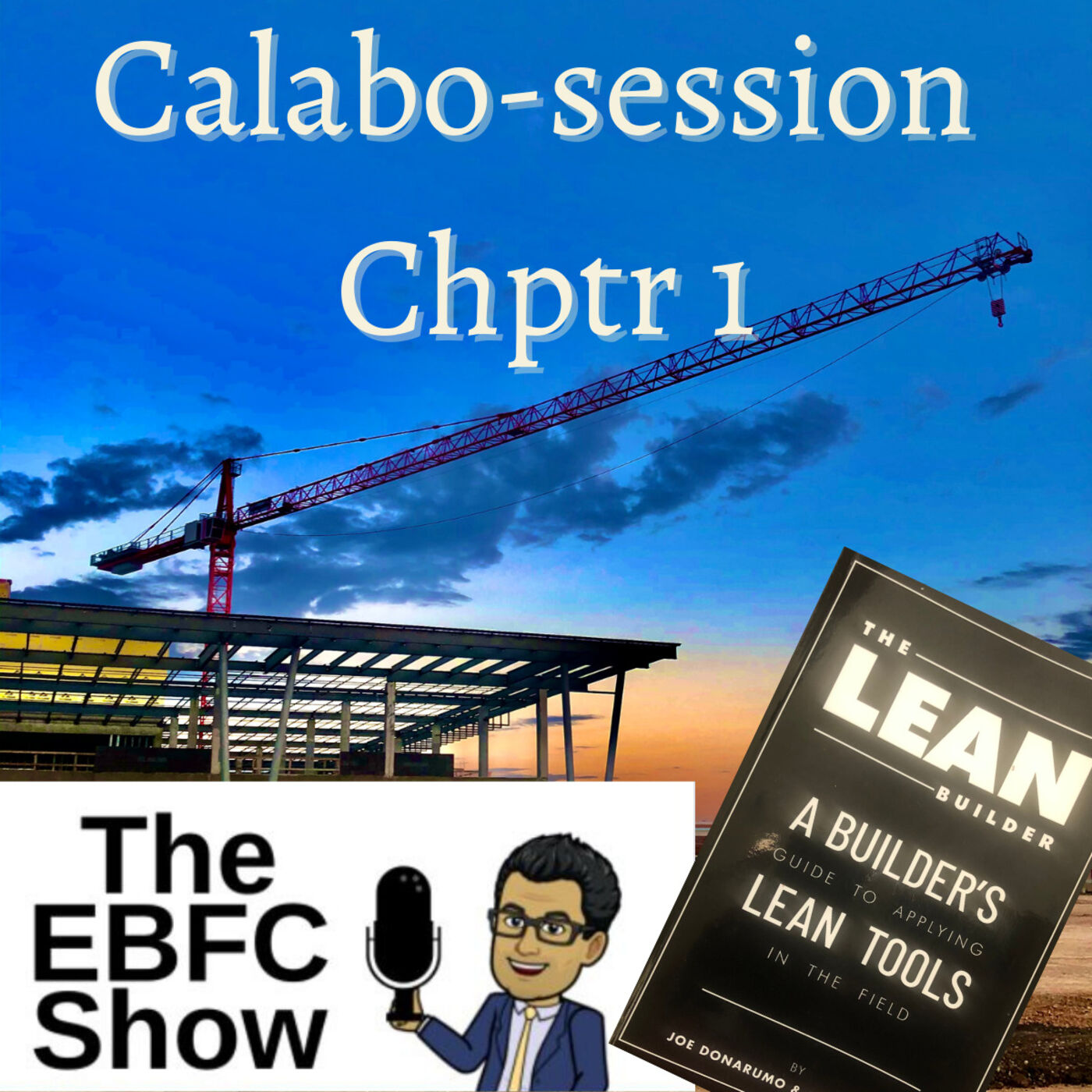
Calabo - Session: Chapter 1 Review of The Lean Builder

 Apple Podcasts

 Spotify

 Overcast

 Castro

 PocketCasts

 RSS Feed

 Amazon Music

 Audible

 iHeartRadio
We have a treat for you! Your Host Jesse Hernandez and Felipe Engineer Manriquez (host of The EBFC Show) team up and share their Lean wisdom as they review Chapter 1 of the Hottest Last Planner Book in Construction The Lean Builder.
This Calabo - Session is the first of 8; we will provide you with the perspectives of the Trade Partner, Coach and General Contractor as it relates to deployment of the Last Planner System. Be advised there are some great practices that come out through the course of these guys goofing around, be ready to take notes.
Listen & Follow The EBFC Show:
https://www.theebfcshow.com/
Expand your Lean Construction Knowledge:
https://theleanbuilder.com/
Connect with us at:
https://www.learningsandmissteps.com/
Support the Mission at:
https://www.patreon.com/learninsnmissteps?fan_landing=true
Yeah, I don't I didn't have that note, Jesse, but that's good.
SPEAKER_03I told you, man.
SPEAKER_00You got this, man.
SPEAKER_03I'm not just a pretty face, Philly. Mostly, but not just.
SPEAKER_00People love you for your brain, Jesse.
SPEAKER_03You're listening to the Learnins and Missteps podcast, where we intend to change the image of careers in the trades. We celebrate the real men and women who have built careers in the construction industry by bringing their personal stories straight to you. I began my career as a plumber's apprentice in the late 1900s. Over the last 26 years, I've had the fortune of meeting some of the most resilient, intelligent, and inspiring people who happen to be construction workers. My career path as a plumber has provided me with experiences and opportunities I thought were inaccessible. And I want you to know that the trades are a place where dreams can come true. These stories are brought to you by three brothers who share a mother. I am Jesse, your host. Our in-house writer is Ernest, aka La Voz. Hello. And our co-host, Renee. What's up? Y'all ready? Yes, sir. Dale. What's going on, LM Family? We got a sub-series for you. It's a little collaboration between myself and Felipe Engineer Manriquez. He's the host of the EBFC show. And we're going to be reviewing, mostly jabbing our jaws and joking around and philosophizing around lean and the application of last planner system in the construction industry. And we're using the Lean Builder Book as our backdrop. You're going to get to hear two sides of the story, right? The perspective of the general contractor and the perspective of me as the trade partner. And through the dialogue between Philippe and I, there's going to be some real easy things that you can use in applying the system. The motivation behind deviating from our typical material was because I want to help you make your day suck less. These things may help you, especially for those of you that are out of the construction industry. Those of you that aren't in the construction industry, there's a ton of stuff kind of behind or underneath what Philippe and I are talking about that you can absolutely apply in your day-to-day. And if you want to talk about it, I'm happy to fill you in and give you all the juicy details for the purposes of making your day suck less. Check it out. Let us know what you think. Those of you that are interested in some exclusive content, early access to our episodes, and supporting the mission, we set up a Patreon account for y'all to contribute even more than you have so far. We've got four different levels. Any level that you sign up for will get you special recognition on the video version of these podcast episodes that we're now releasing on YouTube. We got a YouTube channel, baby. Watch out. We'd love to be able to share your name and let everybody else out there know that you're behind us. So you can find each of the four levels to sign up and contribute at patreon.com slash learnings and missteps. Uh, we love you guys, and here we go.
SPEAKER_01Why in the world are two podcasters reviewing a book? I thought podcasters just talk with their mouth. Give a little shout out to Joe and Keon. So here I've got the book. I will throw a link back to the website so people can start because they've got on their blog like how to do a daily huddle. They have a really good blog article.
SPEAKER_03Yes, they have quite a few great articles. So what I was focused on was my biased perspective as a tradesman. Yes, I'm a lean addict. Confirmed. The rumors are true. But I am a tradesman first. So I wanted to put my head in that space, and as I was reading it, think of it from that perspective. And it's it's just straight up having flashbacks of like the very first project I was on, right? The very first project I was on, where they the the GC said, we're gonna do last planner. And I said, Oh man, this is awesome because I've been learning it. Yeah, and we spent nine hours in the trailer putting sticky notes up on the wall, the whole entire project, and then came back the next day, and all the stickies were rearranged to match that CPM schedule.
SPEAKER_01Oh, GC couldn't help himself, had to turn back that push schedule. It's good. We both got our caffeine. Oh, yeah. Oh, baby, you know it. This is so overdue, man. You and I to be on the show together.
SPEAKER_03I want to build the you know, the credibility and the trust with the listeners first that this is straight up construction and we want to celebrate the people that do the work. Amen to that, brother.
SPEAKER_01We do not have enough of that. There is not too much of that. No one is saying too much acknowledging the people that actually build the buildings.
SPEAKER_04Right.
SPEAKER_01You're crossing the line and you're giving people too much love. That has not happened yet. We're so far away from that.
SPEAKER_03All right, so introduction. I need to introduce myself, right?
SPEAKER_01That's the theory, man. I know it's hard to believe that people don't know you, Jesse. But for the people that don't know you, who are you?
SPEAKER_03Well, my name is Jesus D. Hernandez. What are you also known as Jesse? I am an advocate for the trades, for careers in the trades. I uh I'm a lean enthusiast, and I'm I'm freaking super excited to be doing this with you, Felipe. I mean, you got some real street cred out there in the industry, and for us to do this together is it's a special treat. How about you, Felipe?
SPEAKER_01So I'd be the host of the EBFC show coming at you live from an undisclosed location in beautiful California. My name, my full name is Felipe Engineer Menriquez. For those of you who don't know, Engineer is not my title, so stop thinking about it. It's my name. How did I get that name? It involved my daddy, like so many other people. So that's a long story, not for this show. What do I do? I am uh in charge of the strategy and tactics for lean across a large general contract organization here in the United States, McCarthy Building Companies by day. And by night, I'm a YouTuber in your face, Noah. Noah's my son. So I'm like just like every chance I get not a good YouTuber. Took me from July to now to get you know one subscriber.
SPEAKER_04Come on. Just kidding.
SPEAKER_01Just kidding. But yeah, I practice uh lean construction experiments all over the United States and abroad, helping people around planet Earth have not found a place yet where lean cannot benefit and help the people working. So I'm looking for it. And uh also I love Scrum. Hello, shout out to uh the Scrum Framework. And uh, if you want to know more about me, I'm pretty pretty transparent, all my social media places. So hit me up on you know in these places. And Jesse and I are gonna encourage questions to come and we're gonna answer all the questions because that's just how we roll, right, Jesse? Tenfo did I leave anything out, Jesse? Because I mean you you know me, you've known me for a while. What am I leaving out?
SPEAKER_03You're leaving out the almost invisible thread of lean or maybe um continuous improvement, or even better, improving the work for the worker that that goes through scrum, right? It goes.
SPEAKER_01Oh, I'm so glad you brought that up. So let me let me show you this newest thing I got, Jesse. It's called Snaps FX. Okay. So the big two things that you want to do when you're dealing with, you know, where are you gonna start with lean? So in myself, it's on my shirt too, but since you can't see it, I use my I use my snaps effects to bring it front and center. In order for you to do any of the things that we're gonna talk about today, you have to honor the individual, the people, the person. And respect for people starts with yourself. And then because you're doing that, you will start to naturally extend it to other people you're working with, people in the supply chain, people on your team, people in the trailer, people in the project, people in the office, people in the business unit, people in the organization, people on planet Earth. People we're in a spaceship with no top. The top is wide open and we're hurtling around the sun. Let's be well to each other. We're all in the same place. And then the other part you need, or maybe it happens to you. One of my mentors told me ideas like this are more caught than taught. Continuous improvement is the thing that you want to do as we're seeking perfection. Can I get better? Yes. Can I improve being bad? Yes. You can improve anything, so be mindful of what you're choosing to improve. And those two together really set the foundation for how to do lean things, have a lean mindset, be a better partner. So glad you asked, Jesse. Let me turn that, let me snap that back off. There, now you don't have to look in on my shirt now.
SPEAKER_03You got some serious sorcery over there, big dog. So you run your own podcast. I'm following in your footsteps. And how did how did the two of us podcaster leaners? Are you a non-denominational lean practitioner?
SPEAKER_01I'm a Unitarian church lean practitioner.
SPEAKER_03Okay, okay.
SPEAKER_01Everybody's welcome.
SPEAKER_02So what brought us together?
SPEAKER_01Oh, that's I think uh the first time we got together, I was invited by uh he didn't know it yet, but a mutual friend, Sean, invited me to come do a talk in San Antonio. I think we were in San Antonio, yeah. We were we're in San Antonio, and I was doing a little two-hour, oh, half-day uh how to do scrum. Yep. So it was a half-day introduction to scrum through the Lean Construction Institute committee of practice, shut out San Antonio C O P.
SPEAKER_03Do time in the house.
SPEAKER_01And that's one at the time you were still working for a trade partner at the time that I met you. You were just in transition. You were like you had that you had that smell that you were start to get that GC on you, and uh and you made that you were making the shift, and you saw me never lose an ounce of energy for what was that? Was it four hours or was it?
SPEAKER_03I don't think it was a full day, it was probably a half day session. I mean, I could go to Earthburger after the session, so it was a warning.
SPEAKER_01Yep. Shout out to Earthburger, San Antonio, delicious. And then we bounced around and we've seen each other at a bunch of Lean Construction Institute events. And I think uh I noticed you are probably already knew something about Scrum. So you were you know head of the class for sure. You're answering all my questions correctly, and you had good enthusiasm and curiosity.
SPEAKER_03So now here we are, the host of the EBFC show and the host of Learnins and Missteps podcast. So we're gonna talk about a book that really breaks through all the complexity that some of those damn lean guys out there and ladies add to the practice of the last planner system specifically. And and I'll say it again just in case anybody missed it. It's not that damn hard, and it can be as simple as we allow it to be. And this book does like a phenomenal job of depicting that. What do you think?
SPEAKER_01Oh, definitely agree. So, yeah, the the book, like it starts off like a Disney movie, in case you don't know. In the prologue, people get killed off right away in the prologue.
SPEAKER_02I just wanted to say you're attached, you got a relationship now.
SPEAKER_01You know, it's just like no, it's like Andrew, no. So, yeah, they they started off like a good Disney story where you know, luckily they didn't kill the the mother or the father this time. They killed so it's a fictional story that tells interweaves like the journey of you know two main characters, Sam and Alan. And already I had Joe on my podcast, and the podcast is out, and I told uh Joe that it didn't escape me that Alan's last name is a version of my first name. So I feel connected to Alan. But you're totally right, Jesse. There are a lot of people, and like you were describing when you know we were talking at the beginning of the show, when you first learned last planner, a lot of people try to do this like nine-hour, and I I know people alive today, Jesse. Today, it's 2021. Yes, and they think they believe that you need two days in the classroom before you can go do last planner system. And I completely disagree. So, but it depends on who your facilitator and your champion are. I think there are probably some individuals that it takes a couple days to get onboarded. But I think if you've got a good qualified person or you've read, you know, this black, we'll call this the black book, the lean builder. I think if if someone goes through that, I would a hundred percent already say it right now. Encourage people to try every single chapter, whatever's in the chapter, try that.
SPEAKER_03It's gonna work after you read the chapter. Yeah, after you read the chapter, don't go, don't, don't, you don't need to study and and pontificate and not analyze. Go practice whatever the hell you get out of the first chapter the first time you read it.
SPEAKER_01And Jesse, we we probably we're gonna talk. Uh oh. Can you still hear me, Jesse? Yes, you did the little uh-oh, and I was like, Yeah, you just froze up real quick. No, that's because it's Microsoft Teams. I can't say enough bad things about Teams for recording videos, just so you know.
SPEAKER_04I've never had okay.
SPEAKER_03Yeah, yeah. This is the first time I've had this many glitches.
SPEAKER_01Maybe your Teams has never had so much of this coming through the screen that it can't even control it.
SPEAKER_03Containment that's what it is. It's the aura emanating from I'm gonna just blast, I'm blasting through. You know what? I gotta admit, it's not just you, it's me too.
SPEAKER_01That is true. You do have you have quite the essence there. But to keep the we got to keep the show G-rated for, you know, in case Renee listens to the show. I don't want him to have you know nightmares about his big brother and what's going on. So you mentioned Joe. Joe Donarumo is the author, yeah, good friend of mine. He was and I met Joe at uh a Congress. He was the Dallas Fort Worth, Texas LCI Congress 2019 chair. Yep. I was telling, I think I said on the show, like, Joe, I didn't even know that you were an author until the last day. Joe and I were sitting, we were sitting next to each other and we're about to do a debrief. And I looked in my my gift bag and I was like, What? I was like, is this you, Joe? And Joe's like, yeah, I wrote that book. I was like, You wrote a book? What were you gonna tell me? I was like, we've been on these calls for like a year. Yep, and I don't remember. I must have missed the you know, any call where he ever mentioned that he wrote a book.
SPEAKER_03He didn't mention it because I was that's when I met the two of you because I was uh well you probably don't remember us, but because I was a horrible committee member. Oh, you were on that committee? I was on part of the planning committee, and that's when I first saw I saw you doing scrum using Trello to to manage the the the development and the planning else.
SPEAKER_02Serve the team to serve. Oh, thank you, Jessie.
SPEAKER_03Excuse me, excuse me, wizard. Um to serve the team, to serve the developer.
SPEAKER_01I don't manage anything. I serve, serve and lead. Those are the things I do. Manage is not for me.
SPEAKER_03I'm with you, man. I was there. I I've attended a bunch of a bunch of the meetings, I did a little bit of work, but not one time did was it did he ever say, Hey, I'm working on publishing a book. Right. Um, none of that until until the gift bag came out. Then it was like, Wow, this dude wrote a book. And I you know, I remember thinking like I I know that there was um a time crunch for him to get it published to be released at that Congress, at that LCI Congress. And he never gave any indication that that it was a problem. Uh super humble, super humble in fact and produced an amazing product for a lot of people.
SPEAKER_01So should we dig into the book? Let's do it, maybe now that we've set the stage. Yeah, I've got my little notes here. I'll just hold up my little notes so people can just conceive for a second that I I kind of wrote in there and I got handwriting all over that bad boy. Sorry, Joe, I wrote all over your book. Oh, wait, it's my book, so I can do what I want.
SPEAKER_03Well, you know what's awesome? When I was in school, back in high school and middle school, I would get in trouble all the time for writing in books. And now I'd like to get props for it.
SPEAKER_02I was like, hey, I've been doing this all my life.
SPEAKER_01For the kids that are listening to this who shouldn't be, disobey and write in your books. You'll turn out to be just like Jesse.
SPEAKER_03No, watch out. The kids may like that, the parents may not.
SPEAKER_01Yeah, I say you kick it off, Jesse, because you got the fancy red headphones. And I just want to give a shout out before we start. Some of the things that people might not know is that Joe is a co-author, Keon is the other author, and the two of them together, they wanted to provide, like Jesse was saying, an easily understood link construction resource for everybody, especially leaders in the field. So specifically, Joe is a superintendent, Keon is the an executive executive leader. Sorry, Keanu, I don't remember your exact title. We'll have to we'll title you out in the show notes.
SPEAKER_02Well, he's an author for sure.
SPEAKER_01He's an author. I mean, we know fact guaranteed. I can see his name on the book. He's either the CEO, the COO, he's a C executive suite, and he's got a great beard. And they were they wrote this because, like Jesse, like you were saying, some of the people like really make this stuff complicated, and there's not a good field-focused resource out there.
SPEAKER_03Chapter one. All right, so I'm gonna show you the depths of my philosophical eye.
SPEAKER_02Yeah, please.
SPEAKER_03They're in the very first page, they're talking about you know, the size of the project and and the relationship it has to Sam and his new job and like all of this buildup. And for me, you know what I'm getting out of that is this thing that we do will attach our sense of self or our ego to all of these external things, and in many cases, that can be problematic. And as a as a former plumber trade partner, it comes across quite often when the general contractors team members, whomever they are, you know, whatever level they're playing at, that they have this attachment to something that keeps them from interacting in a vulnerable way. Yes, that's what you think about that.
SPEAKER_01Yeah, that that opening intro, you're totally right. You jumped over. I want to just go back to the first paragraph, only just to note that I underlined with the super thick, you know, seven underline marks that he's drinking coffee. You didn't accept that one, did you, Jesse? And I was like, I was like, something's probably wrong that he's taking a long swig of coffee, you know, right to get it started. I mean, hypocrite alert. I'm drinking a long swig of coffee right now. And so it just says a lot about the you know, the health and the state of mind, and you got to get caffeinated. I was gonna go a little bit deep on you too, Jesse. I'm glad you went there first. And then you're totally right. When we talk about the things that we're on, especially uh, I've been to a lot of project team engagements, and how people introduce themselves either enables that connection or it prevents vulnerability, like you said. And I think 9.9999 times out of 10, it's let's prevent that connection. I'll even tell people when we're doing introductions, don't say your title, just give us your first name and your main responsibility, just so people can know, like you know, what are they in charge of or what are they what are they trying to achieve? Like, if I hear what your responsibility is, that's way more important and meaningful for me and the rest of the team than to hear you have a title. And there are times where I go a week and don't even say what my title is, partly because it's obnoxiously weird.
SPEAKER_03Yes, I'm with you. I'm right there. Not not I'm not with you in that your title's obnoxiously weird.
SPEAKER_01Oh, I thought you were.
SPEAKER_03I was like, No, no, but mine as well, right? Like my title's my title, it's something in in the bureaucracy of payroll in and companies, right? But it doesn't define me, it does a poor job of explaining or or or highlighting that I'm actually a human being, just like everybody else.
SPEAKER_01Fact. Like I'm looking at this paragraph now that you mentioned the second paragraph, and the word superintendent and senior superintendent, like even in a single paragraph, we have hierarchy here. That is fascinating, Jesse. And you are you are special.
SPEAKER_03Watch out, baby.
SPEAKER_01Watch out.
SPEAKER_03But it's in there, right? We carry that with us.
SPEAKER_01Uh just so people to know, like you're paying attention at home and you're gonna read or not read the book. So we've got Sam is the hero of this story. He's the young, brand new, fresh superintendent, recently promoted uh from A Soup to Soup. But he's he's spent some time. Read the prologue to hear why and how he got promoted there. We won't give the prologue away, Joe. So you won't give to all of it away. Oh, we forgot to do the spoiler. Lord Jesse. We're gonna probably spoil the plot of the book. Probably.
SPEAKER_04Maybe.
SPEAKER_01And then uh Alan Felipe or Alan Phillips, as they say in these pages. He is the uh the senior superintendent at the same company.
SPEAKER_03And and Sam's mentor. So here I am again, being very sensitive again as a trade partner. You know, as I was reading through the next page and that first paragraph, the sense I got that the book was building up and highlighting the stresses of Sam that that Sam is experiencing. And the feeling I got was well, that's sweet, but he ain't the only one. You know what I mean? Like, okay, I'm the plumbing foreman, right? You know, at one point in my career, the superintendent for the sheet metal crew, plumbing crew, and piping crew. And you know what? I was drinking black coffee too, and I was like, damn it, I got we got stuff to deal with. But my point is that that sentiment, that experience, that feeling is not synonymous to the superintendent for the general contractor. Every team member experiences that in some degree, and we have to take that into account in order to be able to connect with each other on a human level.
SPEAKER_01Yeah, we're all in it together. Yep, absolutely. If we're all on this project working together, the pain that leadership feels will be felt by all leaders. Yes, and that does trickle around and permeate through to the whole team. Do you you feel you go into jobs and you travel to jobs? I've seen you in airports. We've bumped into each other at different airports, yeah. We have crossing the country. Yes. Um, you walk into a team meeting, a huddle, or just walk in the site, and you can feel the energy of the site if it's if they're doing well or not.
SPEAKER_03Have you ever walked onto a into a trailer and felt like, oh my god, there's some brujeria going on in here. This trailer's possessed. Yeah.
SPEAKER_01Yeah. It happened to me on a job where we actually got, you know, we went through some issues that required additional corporate support. I'll just say that. And then the trailer had a certain type of carpet. It had this like like jungle stripe, zebra, brown carpet. And then I go to my next job. I was like, Oh, thank god, that job's over. The very next job, they brought back the same trailers. And I was like, No, these trailers have the bad jujubi juice on them. We got to get rid of that. And then that job was a challenge, and I was like, it's probably that carpet. So, what'd you get from from the next so yeah? The next in the next section of chapter one, you know, they set the tone, they set the stage, and then they're talking about the client. The the GC here is called ProCon Builders, and the client, it's a healthcare system building that's got multiple phases, and if they if they're already setting it up, like if they do well here, they'll keep getting more phases at work, which is the that's just a carrot. Yeah, 30 carrot almost at the same time. And so, clients, if clients are listening or reading this book, uh, we know we're on to you. We know you all go to the same client school and you tell us that you don't have enough money and you want your building yesterday. Roger that. We got that. But the thing that really jumped out is that the CEO of Pro Builders lives so close to the site that he drives past the site multiple times a day, which is hilarious. And and and and this is the classic thing, Jesse. As I don't know, I don't know how you experience this on your side, but as a a recovering general contractor, I've been in a couple of GC companies, so I can say that with honesty.
SPEAKER_02Yep.
SPEAKER_01As a recovering general contractor, oftentimes on projects, when there are a few trades in the beginning, typically earthwork, uh concrete for foundations, maybe some civil. So usually just a couple of a handful of trades. We waste time or lose time when we're in the honeymoon phase of the job. And then by the time the the rest of the main body of trades come on, mechanical, electrical, plumbing, fire suppression, framing, other finishes. We've lost time when we were in the honeymoon stage when everything felt great. And now we're telling people that just showed up on day one, like, hey, you got to make up time.
SPEAKER_02Yep.
SPEAKER_01And so right out the gate, this is just the classic story.
SPEAKER_02Yes.
SPEAKER_01And you you should see me, Jesse. Like every new job, when it's just a couple of trades, I'm always like fighting like a maniac to lose no time in the beginning. Because I'm thinking about you know, the 45 trade partners coming behind. And when I say 45 trade partners, I'm not talking about people, I'm talking about 45 companies coming behind. We can't get lax in the beginning. Never, you gotta hold, but but Sam being the young charge, I'm getting all fired up, Jesse, because Sam, you made the classic superintendent mistake, and you think that you can just make up time at the expense of other people that had nothing to do with losing that time, they had nothing to do with it, and you're gonna sit there in the meeting and tell these people, like, you need to make up these two weeks. Oh, we had weather impacts, you need to make up the weather impacts. All right, Jesse, I'm gonna take a breath, come back down to calm. Yeah, Sam just doesn't know yet.
SPEAKER_03It's okay because that creates the need to learn because or the need for change, because we're not gonna change if our current experience is comfortable. We will only change when our current experience sucks so much that we're willing to experience the pain of change.
SPEAKER_01And I think the other funny thing is here, and we're still on just the same page. I told you Jesse, we're gonna talk more about this than it took to read it. The phrasing here, when they're mentioning the schedule being off, Sam doesn't use any type of ownership language about the schedule. Thank you. Oh, thank you. See, man, we're on the same page.
SPEAKER_02Thank you.
SPEAKER_01He's like, the project schedule's off, and I I got other there's many every time I saw blame happening in chapter one, I wrote down blame in the margin. It shows up quite a bit. There's a lot of blame being thrown around, but there's no I don't see responsibility being taken until you know we get introduced later to Alan.
SPEAKER_03Yes, in the in the coaching mechanism. Right, right. That includes Bobby MacRae, Hank Hansen, all of them.
SPEAKER_01Tom Morietti.
SPEAKER_03It's the um it's the classic they did it, right? Everyone pointing the fingers at one another.
SPEAKER_01And the people that really did it, Mother Nature, not there to get pointing the finger at because they had some weather. I'll acknowledge you had some weather, but yep, you had earthwork. Why'd you lay back when earthwork was going on? You should have get on the edge of your chair, or even better, stand up. I'm standing up right now, Jesse. So I can do this. Yeah, I'm on my feet, man, because I just cannot be contained in a chair right now. And this is so typical of what we see that I almost feel like we should go to we should go to school, Jesse, and see maybe we sit in a classroom, like a CM class, and like when does this get taught at school? Because it comes out so consistently, it must be taught at school.
SPEAKER_03This is how to do it, go ahead and chill out at the beginning, yeah. Ouch, ouch, okay. Well, you know, and on the same line of thinking. So you you go ahead and meditate for a few seconds. I had a similar experience, right? Like, wait a minute, I didn't make it rain and I didn't force you to let things slide. But now you're telling me we're three weeks behind, and it's up to me and my team to get you back on pace, but you're not treating me like the solution, you're treating me like I am the barricade between you and uh us, right? Back then and back in the day, there was no us.
SPEAKER_01It's us versus you.
SPEAKER_03Correct. And so it was like, all right, well, you know, we lost three weeks, the schedule's behind, and you need to make it up. What are you gonna do? It was like, dude, um I'm gonna do what's in my contract. Like was it in your contract to get me in here late? Because you did a great job at it. Thank you. Now, as you said, uh, you're a recovering general contractor.
SPEAKER_04Yeah, still recovering.
SPEAKER_03I'm trying to reflect and go back and take on the character or the mindset that I practiced back then, right? Before I was exposed to lean and last planner system and like respecting people. Like I wasn't really good at that.
SPEAKER_01I'll take you back there. Jesse, I'm gonna issue you a delay letter for being late. It's a notice of potential issue letter. I'm basically putting you and your company on blast. Yes. You cause this delay somehow, some way, per our subcontract agreement. You delayed the job, just FYI. Are you back now? Did I bring you back?
SPEAKER_03Yeah, yeah, I'm back. Like, you know what? You're gonna send that. Go ahead and send it to my mom, too. She's probably gonna care more about it than I do.
SPEAKER_01How about that? Sorry for laughing like so instantaneously. I didn't know that your mama was gonna be part of this conversation. Oh, yeah.
SPEAKER_03Yeah, that was my tip, typical. Who do I need to call? Call my mom. I don't give a shit. Yeah, this situation, I'm here to help you, but if you want to treat me like the problem, I'm gonna go ahead and act like it. People loved me, Felipe. It's a good approach, man. I like that. Sorry, people who say that guy's I thought he was a lean guy. He sounded like a jerk.
SPEAKER_01Yes, yes. The best lean guys are recovering jerks. The only thing that I would call shenanigans on, where they really where they took they went so far in the story that I thought not even possible. So here it is. You're not gonna even you're not gonna even guess. Like, what's of all the stuff you heard, all believable so far. Yes, one thing, Joe and Key on that. I'm just gonna call BS on. So the team knows they're behind schedule because Sam has been pushing schedules at them. And even though they're behind schedule and they're having these talkings too with people, good old Roberto from BB Electric. Shout out to my electric electrical brothers, brings donuts to the whole team. We have a trade partner bringing donuts to a team that's behind schedule. Don't think so. That's where now I have seen many times where teams have shifted to using last planner system, and then suddenly the trade partners do actually buy even croissants, they'll even go all the way to croissants, they'll jump right over donut. Yes, and if you're really lucky, depending on where you are in the country, they'll get a cronut, which is really tasty. But you Jesse, you and I should not be eating cronuts, just FYI.
SPEAKER_03Oh no, no. I ran, I got my run in this morning, and I need to practice discipline. So, well, look, I have a habit of jumping too far. So you can't.
SPEAKER_01I'll pull you back if you jump too far. I'll I'll I'll drag you back.
SPEAKER_03Yeah, and so that's another um exhibit, exhibit A of my trade partner, former trade partner mentality. If I saw open ground, concrete slash as soon as they took down reshoring, yeah, I flooded the job with pipe and duct before you needed to be there. Yeah, so I yeah, I will we will benefit from you yet, like wait, back it up, back it up just because this area is open does not mean that I've green tagged it for you to get in there, Jesse.
SPEAKER_01I know you look at all these, see all these pages of the book, ladies and gentlemen. That's fertile ground that Jesse thinks he could jump right to, and I'm gonna pull him back to the the page we're on.
SPEAKER_03Back to come back to reality, Jess.
SPEAKER_01I'll do the same. And I and sometimes, Jesse, I go too far back. Like I might go back to the prologue a couple times. Uh-huh. If I feel like we're having too much happiness, I'll just remind everybody that Andrew's dead.
SPEAKER_03Andrew's dead. He's gone. Yeah, let's think we got to keep it real. Don't forget, Andrew's gone.
SPEAKER_01Andrew was Al Alan's son, for those of you that didn't aren't gonna read the book, just so you know who it's like. You're just wondering, like, who is this guy? He was best friends with Sam.
SPEAKER_03Yes, they're throwing up graduated school together, they joined the military together. And then you know real life happened. You know what? I think people are gonna say, Man, this book sounds interesting.
SPEAKER_01It is! That's why we're studying. It is it is interesting, it's very affordable, too. So I mean, I got it for free. I just had to go to a conference and pay over a grand.
SPEAKER_03The next space that pulled my attention, it's on what page 12, second paragraph or first full.
SPEAKER_01Oh, we're we're right together, man. That's where I'm at, too.
SPEAKER_03The sentence says Sam tried to keep them engaged, but it seemed like the foreman either didn't want to speak up or only wanted to gripe about problems without offering any solutions. And so automatically I have a problem with the connection of problems and solutions, but that's that's that's another book. What this thing triggered within me was would you even freaking listen? Right? I'm thinking I'm the former foreman in the trailer, and we got issues. Would you even listen? Too many times I've brought situations up, and I'm just saying, hey, Felipe, you know, there's this issue down, uh the the manhole hasn't been installed, and I need to make sure that that that entry point is exactly as the drawings show. I don't even get to finish, right? Like, because I'm going to say, if it isn't what I can do is X, Y, Z. But before I get to that, what do I get? I don't need your problems, I need solutions. Oh, well, if you shut your damn mouth, you might hear it. Sorry, sorry.
SPEAKER_01Oh, that's okay. And it's like, and I'm as you were talking that I was like, I was flashing with you to that situation. I'm thinking, you're talking to the superintendent of a site, and they've already told you probably every day, 10 times a day, I'm the superintendent. This is my site, I'm the superintendent, I'm in charge. Why aren't they leading and making enabling your work?
SPEAKER_03Oh, flashback. Yeah, you know what my my favorite accusation was? I'd have a general contractor come up to me or a member of the general contractor team and say, you know what the problem is here? Problem is leadership. And I would smile and then say, I agree a hundred percent. In case the listeners didn't get it, the GC's supposed to be the leader, but they're accusing you of not leading. I'm not leading. Yeah, thank you for that.
SPEAKER_01And I I I can't think of a time where I've been on a site, and I've been on sites for over 20 years, so I'm old and crusty. I don't I can't think of a time where I ever felt like a trade partner or back in the day, when I go back to the old days, where a subcontractor was not effectively leading their crews. I never saw crews at a at a company running over each other or hurting each other. And I know and I know I I've got some friends that work in the trades, and they tell me these amazing stories about intertrade competition. Like among a single company, there'll be crews engaging in you know non-ideal tactics with each other. Yep, but I've I've just not seen it yet.
SPEAKER_02Right.
SPEAKER_01So I'm sure it's out there, but I haven't seen it. But that that leadership problem, Jesse, is definitely have heard it said by many a GC.
SPEAKER_03Now I will say the industry has come a long way uh uh in terms of leadership capability. I I can remember back when '95, first job side I walked on, and it was cussing, screaming, threats, hard hats throwing, like it was a contentious environment, and it has evolved quite a bit.
SPEAKER_01So well, fast forward you a decade when I was on the site, middle 2000s, tables being thrown, hard hats being thrown still. So it depends where you are.
SPEAKER_04Yep.
SPEAKER_01Yeah, so maybe where you were, it evolved a little faster. I was, it was still a decade behind you. Another thing I wanted to show here was that uh he's basically going over this and then complaining about the trade partner Foreman. He just drove everybody through an hour and a half freaking meeting. Yes. An hour and a half and complaining about production, complaining about production, trying to cajole people into just doing what? What are the number what's the number one tool a superintendent goes to when they're behind schedule, Jesse? Supplement your manpower, supplement your manpower, Jesse. You go to the head of the class. Let's get more bodies here. Oh, you're just behind because you don't have enough people. Let's just jump over the fact that there's no flow on the site. Yes, let's jump over the fact that nothing's ready as you've scheduled it on your beautiful tri-colored Gantt chart that says that I'm supposed to this is critical. If this is critical, why can't I just get it? Why can't I get at it?
SPEAKER_03And it's add more people and do more waste faster.
SPEAKER_01Yeah, it's like not explaining to young Jesse, the plumber, why he shouldn't just put all that pipe up in this area just because it looks open and available. That's anti-flow. Absolutely.
SPEAKER_03So, what was the next area that caught me next?
SPEAKER_01The next the thing that caught me next is after the meeting's over, so he's just been in a meeting for an hour and a half with all the trades running this uh MOB. I think it's an MOB, right, Jesse?
SPEAKER_02Yes.
SPEAKER_01Medical office building. And not even being out of the meeting for half an hour, his phone's blown up.
SPEAKER_02Oh, God, yes.
SPEAKER_01Now I've been with a lot of superintendents over the years. That's one of the that's one of the things that I look at when I'm with them. How many times does their phone ring during the course of being together? And I find that the more it rings, the more behind schedule they are. There's a correlation there, right? The less it rings, the more ahead or on schedule they are. So nice touch, Joe. I see what you're doing there.
SPEAKER_03Oh, yeah. So they did a good job of presenting that dynamic. Oh, like, man, we just had a damn meeting, we just talked about it, which is likely he did most of the talking. And then all the questions come after that.
SPEAKER_01Yep, because people didn't have a chance to speak up.
SPEAKER_03Right.
SPEAKER_01He they got lectured for an hour and a half, is more likely what had happened. Correct. And then the the next interesting thing on the just the bottom paragraph of this page, when they mentioned that Alan, his uh he's like a father figure to him, but his mentor, G a senior superintendent of the same company. Um, what jumped out at me is that he's been doing it for 32 years. So you got a you got a brand new kid. We'll just call him a kid. He's a man, but he's like a kid, and then you got somebody 32 years, not 32 years older, 32 years of building experience, like working for three over three decades. And that's the industry we have today, ladies and gentlemen. When when Jesse and I first got into this business, we didn't have that gigantic spread, right, Jesse? Right. And today, in the 2020s, we do have now multiple generations. I think Joe even said on the interview with him on my show, uh shameless plug EBFC show, Joe Domarino. Check it out. Joe said we have five generations working on project sites all over the US and abroad. The same is happening in other parts of the world as well. What jumped out at you?
SPEAKER_03What I appreciated about that transition was that Sam was open to receiving a different idea. Now, in this case, it's a very personal relationship. Alan was homeboy's dad, and they grew up together, and so there was that natural nurturing connection. Nevertheless, Sam was open to say, man, today is whooping my butt. And then Alan says, Ah, tell me more. He starts doing the ninja lean practices of what's what tell me what's going on, what happened? And it was a beautiful transition into the mentor, mentee, or coach-learner relationship that it's not explicitly called out, super subtle, very smooth but critically important. And I think for the reader, I guess my recommendation would be you don't have to wait till it sucks. Um, it doesn't have to be somebody you grew up with. There are people out there that have some tools and experience in applying the tools that are happy to help you, and I'm pretty sure Philippe is one of those. And I know I'm one of those. So so reach out and and get some help.
SPEAKER_01No, I was on a site too where I was riding, I was doing a ride-along with a retiring superintendent who's gonna. I found out he's retiring this year, uh, and his nickname is uh Pee Wee.
SPEAKER_02Pee Wee.
SPEAKER_01Much love to you, Pee Wee. Pee-wee's got an amazing YouTube channel that kicks my kicks mine down. Like Pee Wee's got to figure it out. We've got a lot of cool toys. Uh but I told Pee-wee, I said, We're doing this ride-along, and he's like, What what are we doing? What's the purpose of why you want to ride with me? And I said, Pee-wee. I'm just watching the things that you've set up. I know that you know something. You know something, and you've had experiences that I don't know. Yes, and for as much experience and expertise as the crew has attributed to me, there are things that that you know from hands on. That the only way I'm gonna get it is if you you know drop that knowledge on me or put me through the experiences. So that's what the purpose of this ride-along is. I'm trying to soak up anything that you want to give. That was one of the best experiences I had. I mean, we hung out for a day. He took me, he did things in the Ford Escape that I thought a Ford Escape could never do. Go off road. Yeah, if you don't ask, you know, and a lot of projects, Jesse, have people like that. And they just never get asked by people on the team, like young, especially younger people that have been trained and told, like, okay, you're in this role now, and they think you just got it. And Sam was the same way. In the book, Sam's like, I'm this, I'm the superintendent now. I got this. It's like, no, sometimes you don't got this. There's some days that I don't got this.
unknownYeah.
SPEAKER_01And sometimes I gotta call, I gotta call up and down the chain or horizontally and get uh some more perspective that happens. But you're right. In that in that section where they're transitioning, and people probably missed it. Alan never here, where he's just finding out what's happening, he never gives Sam advice. Right. Not right here. Yeah, as a lean goody good. That's the number one mistake to turn people off. Someone comes to you with a problem, and they're still in the middle of telling you what the problem is, and you jump in with the you should do this. You just failed.
SPEAKER_03Yeah, I'll give it to you. Come on, give it to me.
SPEAKER_01Yeah, don't do that. Violation. Yeah, I don't I didn't have that note, Jesse, but that's good. You uh I told you, man. You got this, man.
SPEAKER_03I'm not just a pretty face, Philly. Mostly, but not just.
SPEAKER_00People love you for your brain, Jesse.
SPEAKER_03So on page 15. So I'm probably skipping a little bit.
SPEAKER_01That's okay. All we skipped in those two pages was food. So it's good that we're skipping that right now.
SPEAKER_03Oh my god, yeah, because they're talking about chorizo and egg, uh, bean and cheese. Uh, so edit recommendation in the book, it says bean with cheese. The appropriate language is bean and cheese.
SPEAKER_01That'll be for the updated edition.
SPEAKER_03Yeah, yeah. I won't charge for that. That one's free. Uh towards the bottom of page 15. Again, he's he's uh Sam's talking to Alan, right? He's like, Well, the guy's been complaining that they need some riprap because of the weather, it's gonna rain, their trucks are getting stuck in the mud, and the word complaining again, hair on the back of my neck stood up. I think we have a choice to receive information, and the trade partners are surfacing a problem, and we need to celebrate that. Yes, but Sam's still early in his journey, so he's not celebrating it, he's receiving it as a complaint. The reason the hair on the back of my neck stood up is it reminded me of a project. I was I was on a few projects, right? Yeah, at least two, and I took over this project for whoever was leading it. We're having issues, and they wanted somebody else, and so they said, Jesse, go, I guess, you know, poor poor GC. And and so you know, I had to go out there and understand the current state. So I went and walked the jobs to see where our progress was, started understanding the drawings and started figuring things out. And what I what came up was they didn't have a chilled water supply coming from the central plant to this building. They, I mean, they were screaming and yelling, we need conditioned air by X date. And I I like I can't give you conditioned air by that date. We do not have like there's there's not in the civil drawings, it's not anywhere. We don't have a chilled water supply to the building. Nowhere on the it's not anywhere. Yeah, what did I get? I don't need your complaints, I just need you to get me air. Give me a date. I said, okay, I will get you air on Valentine's Day just because I like you. So fast forward, Valentine's Day. We turned on the air handler units, yeah. And of course, they come yelling, like, what the hell? Like, like, I got you air. Yeah, but we need conditioned air, we got finishes, wah, wah, wah. I'm like, okay, I cannot do that because we have no chilled water supply to the damn building. Yeah, and of course, I was the jerk, and I may have leveraged that a little bit. But had they just been open and received, that I was surfacing a problem that we could have worked to plan through, we might have had conditioned air. But instead, they took it as a complaint. And so that's a critical thing. And that you know, as the book goes on, Sam starts shifting his thinking, right? He becomes uh a better listener and and starts to celebrate problems. That was the the flashback that that piece took me to, sir.
SPEAKER_01Yeah, here in the in this section now we've got Alan is he's not telling Sam what he's doing, but he's taking Sam through in what we know in lean thinking is the PDCA process. He's starting to help him craft, he's understood the current state, and now they're making a plan together. He's not giving him the plan, right? He's saying, uh you've you've said this thing about the schedule and this complaining thing a couple times. Would you be open to trying this so that it would help you raise these up? And he's telling him that getting the the trade partners to talk and complain is actually a good thing. And and then here on the next page, we go to page uh 16. Now that he's given him a solution to try and experiment with the trade partners, the very top of the next page, Sam blames the architect for why they're bought.
SPEAKER_03It's it's not me, it wasn't me.
SPEAKER_01Yeah, wasn't me. Like now that it uh now that I can't blame the tradespeople, so who else is on this team? Who and and who's not in the room?
SPEAKER_03Yes, you ever notice that, Felipe?
SPEAKER_01This is interesting how that happens.
SPEAKER_03Well, what's the problem here? Let's do the five who's and the last the fifth who is gonna be the people that we didn't invite, the people that are not in the room. Is that coincidental?
SPEAKER_01I don't think it's coincidental. One of the one of the weird things that I bring to project teams is this idea that it's our project and we are responsible. There's no one else outside of here that's gonna solve our problems. Superman is not coming. The Avengers are not gonna show up. Like, we got this. All we need, we put our heads together, we got this, we're responsible, we control the site, and together we're gonna make it happen. And that includes people that are supporting the site, like people from the design team, people from the owner side, they're included in that. We got this, we.
SPEAKER_03Yes, we that is the operative word. Have you have you met that person yet that built the whole entire building and executed every scope all by themselves?
SPEAKER_01Not yet.
SPEAKER_03That I I I hear a lot of people say, I did that job, I built that.
SPEAKER_01Yeah, um, can I can we say I was a part of it?
SPEAKER_03Uh I that that's can I say I'm a part? I I contributed to that. I was involved with that. Yeah, yeah. I served on that project.
SPEAKER_01There you go. Love the served. In the next section, after Sam drops the it's the architect's fault, his mentor Alan just eats silently and waits. It creates that space for waiting. That's a what we call a weak signal back to Sam that I heard you, but I'm not gonna acknowledge that nonsense that just came out of your mouth. Did you hear you? Right?
SPEAKER_02I heard you, but did you hear you?
SPEAKER_01Yeah, just let that little space be there, sink in, and then he goes right back to blaming our favorite trait of all infinity plumbing.
SPEAKER_03Damn, hey man, you know.
SPEAKER_01Did you get triggered when he did that on this page? No, I made a note here to say just get Jesse riled up on why the plumber just can't keep up. It just says right here, plumber cannot keep up because they didn't adequately staff their crew.
SPEAKER_03That may have elicited a response if I wasn't desensitized to it always being the plumber's fault. Always the plumber's fault. Right. It rained, there's water on the floor, it was the plumber. There's no way it was the rain. There's no way it was the waterproofing, there was no way it was the roofer. It's water, it was the plumber.
SPEAKER_01It could have been the fire suppression because they're they're never on site.
SPEAKER_03That's not nice. We gotta be nice. They are there.
SPEAKER_01Eventually we let them come.
SPEAKER_03You know what I think it is, why it's always the plumber's fault. It's like hidden envy. Because we yeah, yeah.
SPEAKER_01I don't know where you're going with this. Where's this going?
SPEAKER_03So we get paid to play in the dirt, right? And I think some people had really controlling parents that they couldn't play in the dirt. We get paid to play we get to play with fire.
SPEAKER_04Yeah.
SPEAKER_03And and I think you know, there's a lot of people in the industry that are afraid of fire and afraid of you know hurting themselves. We get to play on machines and equipment too. We get to play with lead and mercury, um, we get to play with water, right? Like we get to do all of those things, and very few trades get to do all of that. So I feel for y'all out there.
SPEAKER_01And don't forget, you get to to hang toilet accessories in some jurisdictions. Where some people are like, you want to hang that, and I can make all kinds of jokes about what kind of toilet accessories you hang, but I won't go there because I know our audience is very diverse.
SPEAKER_03Agreed, agreed. Yeah, I was gonna make a comment about laying pipe in all positions, but we'll skip past that.
SPEAKER_01Darn that affinity plumbing, just getting behind. Damn it. Freaking plumbing. Sam's go-to is like if they just had more people, we'd be okay. Yes, yes, it jump jumps over that they're doing rework on the first floor, doesn't even say why, doesn't even care why. Yes, just assumes that that the plumbers decided to rework things just because.
SPEAKER_03Just because, right? We were just because we're gonna go practice. So, one note I put on that page, page 17, where we talked about we table issues that don't involve the entire team. So now he's talking about actually having a daily huddle, yes, right, and and the mechanics of that. And one thing that I've been able to observe over and over and also experience myself is it takes practice to develop the skill of tabling an issue and putting it in the parking lot because we're action-biased people, people that work in construction, we like making things happen, we like coming to the rescue with the with our cape on, right, and firefighting. And many situations require that, and that's okay, but it is definitely a skill that needs to be built over time with many, many repetitions. Uh, and I think this also speaks to why the daily huddle was put at the beginning of the book because it's a good place to start. Why? Because you have very you got tons of cycles of to PDCA. Test it, test it, improve it, test it, test it, improve it, test it. Like every single day is an opportunity to evaluate it, improve it, and and and deploy the improvement for the next day. For the new reader or the individual that's coming to this concept of daily huddles for the first time, make sure, like it's not easy, it's gonna take practice. And the hardest part for me, anyways, and that I've seen many uh superintendents and project managers battle is not chasing that rabbit down the hole, like put it, write it down on the board, have the huddle, let everybody go back to work, and then go chase the rabbit.
SPEAKER_01I've not seen that done successfully well. Yeah, like especially when it when it starts, and and so here he in and I like your that's a great idea. I didn't even think about that, man. There's I think there's 222 work days a year, give or take. If you work Monday through Friday, that's 222 chances to get your daily huddle right. And I think a lot of people don't they jump over that, they don't even think about that. And then so, yeah, that's good. Like, is your huddle better every day? And if it's not, you're not doing that second thing that I said early on, like, why would I do this? Seeking perfection, continuous improvement, right? So don't let that opportunity go go by. That's 222 chances to get better and make it better for the people there. The huddle has a very low entry, like there's it almost doesn't take anything to start a daily huddle. All you got to do is just agree, like, hey, right before coffee or at coffee or after coffee, depends on where you are. Coffee break is like sacred. So maybe you say like at 9 15, 10 15, 7, 7:30. You know, pick a good time that makes sense for your crew. There's no universal time answer, by the way. Listeners, readers, watchers, there's no perfect time because it it's dependent on the people coming there. So when you pick your good time, you were just gonna stand up, and they don't even start that way, start it wrong, but most people sitting down, fail. It's a they got you gotta start somewhere, and all you got to do is talk. So it's like really easy to start. But like Jesse said, that parking lot when issues come up that you can't resolve, and in a huddle, just like in the daily scrum. There you go. First time I mentioned Scrum, I think Jesse. No, no, but you do not solve problems in the daily huddle. The daily huddle, the main purpose, why it exists, it is there to help improve communication flow. That's why we need it. And I don't see that jump out in the book. Uh Keon and Joe. Um, maybe it's in the we'll get to the back. We're taking this book on in order. You need to improve that information flow. And that's what most, especially larger projects, where you have more than a handful of trades, you need to let that communication flow. And the one of the fastest ways is like we're doing right now face-to-face communication.
SPEAKER_03That's it.
SPEAKER_01Nothing's faster. Right. And you see, software companies keep thinking about it, but nothing's faster than face-to-face. And what were you saying about your commitments, Jesse?
SPEAKER_03When we're talking, when we're speaking face-to-face, the magical, intimidating, scariest word I've ever been faced with, commitment happens. If we're all in the same room and I say I'm going to do something, I am much more likely to do it. Or no, I'm not gonna say much more likely. I will do what it takes to fulfill that commitment. If I'm if I don't say it in front of people, you know, I'll use some the they they kind of touch on it, right? I use some soft language, I'll try, I'm working on it, I'll give it my best.
SPEAKER_01Non-committed language. I'm very familiar with it.
SPEAKER_03Right?
SPEAKER_01Very familiar.
SPEAKER_03But when when them huddles are are clicking like they need to be clicking, yes, I will get that done by 9 a.m. tomorrow morning. What does that mean? That means Jesse just opened his damn mouth. And if we got to work late today to be done by nine o'clock tomorrow morning, that's that's what we're gonna do. So it fosters that commitment, that individual ownership, which in turn takes away this other abused concept of accountability. You don't have to hold me accountable. And Felipe, you really can't. I am accountable to me and the commitments I make. Right. You can fire me, maybe. You can you know send an email and complain about me, get me off the job, but that's not holding me accountable, right? I am a com out, I am accountable to my commitments, and so having those conversations face to face, standing up about the specific goal, the project, the endeavor we are on together establishes ownership, and through ownership, we have commitment, and through commitment, we have accountability, and you have trust.
SPEAKER_01I mean, you've been you've been dancing around trust. I was waiting for you to drop the T-word on me.
SPEAKER_03No, no, no. I'm still getting over the commitment word.
SPEAKER_01Yeah, no, commitment is even hello, it's one of the scrum values. Wow, there's a genius in in Ken Schwaber and Jeff Sutherland. Jeff asked Ken, like, you've been working with project teams forever. What makes the best teams really gel and move way beyond the traditional teams? And he said Ken didn't even blink an eye, and commitment was one of the first things out of his mouth. Commitment is critically important. And I'm thinking now, Jesse, like you talked about this, and I don't know how the idea sparked, it kind of sparked between us. Like there was just a fire between us, and then we said we should do this thing for our listeners so people get a chance to see how do we read these books. So you're getting like pulled behind the curtain here and looking into our minds, like when we read, because you know, some people have said that this book is too simple. And I tell people, like, you know, there's a lot of stuff in between the lines here. You might not just have had enough experiences, or maybe this book's not for you right now, right? But for other people with a lot of experiences, and maybe I'm just weird, and you're definitely in the I'm weird with me, Jesse. It's important because we're reading this book the same way, and so for the listeners out there, you got to put yourself in it. Get in the story, and that's what I really love about this book is that it's a story about you know, Sam and Alan and their experiences, and that's for me what makes really brings these concepts to life because I could give you a checklist with like eight bullet points to start a daily stand-up or a huddle that's not gonna get you there.
SPEAKER_03Agreed a hundred percent. You gotta go get dirty. Yes, start where you are, start now.
SPEAKER_01If you're on a crew and the GC is not doing stand-up meetings, do it with your own crew. Don't wait for the GC to come and show you to do something, please. You're probably already doing it. But look, are you doing it like this where your your meetings with your your people are getting better every day? If they're not, that's a little thing to just tweak. You just become aware of oh, this can be better. We can talk about safety, productivity, and I could get to know my people better all in the same 15-minute span of time.
SPEAKER_03Transparency moment. When I I was introduced to Last Planner System as a trade partner, and we would practice it uh with or without the GC. And most of the time it was without the GC because there were very few general contractors that were using it back then, or uh, or rather, let me let me rephrase that not using it, learning and practicing it back then. But the daily huddle, I don't I really don't know why I missed that. We never did it, I never taught it, I never practiced it, and now experiencing the the value that it can bring, I wish I did.
SPEAKER_01Yeah, uh for those uh last planner nerds out there, the daily huddle shows up in conversation number four. The what did we do?
SPEAKER_03I missed that part.
SPEAKER_01It's not it doesn't jump out at you in the five conversations, but it's in the did conversation. You gotta you take that moment to look back, and then perfect transition here, Jesse, to the script. You know, back to the book. We've got uh the daily huddle script example. Now, people do not become a daily huddle lean builder cult and think that these are the only three questions that you can ask daily huddle. Standard, do not violate. These are good first questions, but again, honor the team. Honor your I can't say enough. Like the people coming to your group that are on your crew, that are at your huddle, they're gonna have ideas for how this can go. Start somewhere. So you have a standard. I mean, if you're gonna start start with the script, it's okay. First question I got here, and Jesse told me which one of these three you really love. They're gonna go around the room, and every foreman's gonna tell people three things. Here's the standard script. And I'll just let me just tell you what it really is. So even without looking at the book, because you know, Scrum Master's got a scrum. You're looking back in time to the past. So the first question has to be a past question, or should be, don't have to be. Let me let me put my gloves on.
SPEAKER_03Okay, yes, yes.
SPEAKER_01Looking back to the past, looking to the present, looking to the future. So your three questions are around that. Those three questions are as old as human beings have been on earth with language. I found those, like those, those stand-up questions go all the way back as far as I found it so far as 6,000 years ago. But I'll keep looking to see if it goes further back. But those are old questions that really work. There's a reason why we keep asking these three questions for 6,000 years and counting. Yeah, and probably older. But the first question that he asks here, Sam says he's asking people to answer, where you where were you working? Where are you working today? And how many people on your crew, and what constraints are in your way. So, constraints in your way is the forward facing to the future. So, for something to be in your way, that means future upcoming work or preventing you from starting now, getting off of the present. Where are you? Tells me where you've been, and then what you're working on now tells me what you're committing to, because we want to get Jesse to commit to everything. He's got that high responsibility, I can tell. And then going forward, you know, what could block you from achieving Achieving your goal. Classic huddle questions. Which one do you love, Jesse?
SPEAKER_03My favorite one is the constraint question, right? What is what is blocking you? And you know, it took me a while to for my understanding of constraint to develop to where it is now because before I looked at it as a binary situation. It was either going to keep me from completing or not. My understanding now is it's not keeping me. It's more intense than that. It's anything that would cause me to deviate from my original plan. Meaning, I may still be able to finish, but it's gonna take me longer. I may still be able to finish, but I'm not gonna start when I wanted to. That's a constraint. Anything that is going to or impact the plan is a constraint. And it's my favorite question because now when I share that with the group, we can all attack it together. Right? I mean, I've seen some beautiful situations where a trade partner will bring up a situation like, man, I know I need to do that, but my PM called the forklift off yesterday, and we're gonna have to manhandle that up the stairwell, so it's gonna be later today. And then the other, you know, the brick mason says, Hey bro, I got you, man. Meet me after lunch, let's hook up, and I'll fly that stuff up there for you. Like when that kind of thing happens, it's like, oh, I'm so happy. Like, it's awesome! Like, it's beautiful, like we're a team all of a sudden. Yeah, uh, and so that that that's that's my favorite question, right? Where were where was I? What am I working on? That's good because that's where my brain is always. But what do I really need help with? Man, I need some help with them damn constraints. Right, and I've heard this question so many times. How do you get trade partner buy-in? You ever heard that question?
SPEAKER_01All the time, and I and I tell people like I don't want to be a jackass, but I don't have that problem, right? I was like, I've never had the and I wrote it, it comes up, I think it comes up in the next chapter uh that we're not gonna get to today because this has just been too much fun. But the uh the uh that how do you get people to buy in? It's exactly how Alan got Sam to buy into this experiment. Yes, he offered help. Yes, that's how you get buy-in. So and I wrote later too, there's a part where someone's coming at this very skeptical. I think it's Roberto. Roberto's is acting, acting is the role of the skeptic for the trade crews, is Roberto, yes, the electrician. That I already told you I love him. I love skeptics, I love people that resist change more than people that just say, Yeah, let's just do whatever Felipe says. No, resist. Try to resist me, Jesse.
SPEAKER_03Resistance is futile.
SPEAKER_01But I like that idea, you know, constraints are good to have. We already, when you're coming to a site, you already have a constraint set up. You've got a when you got there, all the things that set when you got there, and then you have like your company has a goal for you to get out of there. At some point, the project's got to be over. So you at least have two giant ones. Yep, you have, and those are like I look at constraints like boundary conditions, and sometimes I set constraints on purpose on myself to grow. Like I'll make something harder on purpose so I can just see like, can I overcome these conditions or not? But don't do that to your tradespeople, don't do that on projects. The work's hard enough, right?
SPEAKER_03Right. Well, but you know, I've heard you talk on one of your one of your episodes, it was with one of the scrum and agile practitioners, how constraints unlock creativity. And and on projects that I've seen that have like a postage stamp footprint where there's no laydown area, there's no storage. Man, those projects do a pretty good job of supply chain management and just-in-time delivery. The projects that got acres and acres, they got all kinds of garbage, and it's the same team. It's not a judgment, that's uh confession. For me, it's the more the fewer the constraints, the more relaxed I am. The more constraints, the more creative and intentional I am about approaching things.
SPEAKER_01Yeah, if you're on a giant greenfield site, it's almost impossible to convince the team to do just-in-time delivery, even though it's gonna cost you you're gonna blow every single code you have, no matter what trade you are. Yes, you think you have all the area in the world to do it. Constraints are really good to have. And I I want to give a shout out to another book that's also told in the way of a story, Jesse. I don't know if you read it. It's called The Goal.
SPEAKER_03Oh, yes.
SPEAKER_01By Eli U Goldrat.
SPEAKER_03Yes.
SPEAKER_01And that book, until I read The Goal, which is a fictitious book about a factory manager. Yeah, I never understood how to actually use constraints to my benefit. And that's even a phrase I told my son, like, I'll give some free parenting advice right here for a second. You didn't ask for it, but here it is. I told my son, understand what system you're in, and the system's inputs, processes, outputs, and feedback loops. Try to understand that, and then make the system subservient to your needs and wants. Take advantage. Whatever system you're in, take advantage of it and make it work for you.
SPEAKER_03Yes, exactly.
SPEAKER_01And the same with constraints. Exploit the thank you, Jesse. That's the word I have spacing on. I'll take another swig of my black coffee. Take it exploit the system. That's what we learn in theory of constraints.
SPEAKER_03Yes.
SPEAKER_01Ela you goldrat taught people through a story the five steps to maximize constraints and exploit them for your benefit of creating flow.
SPEAKER_03104. And so back to how do you get trade partner buy-in? This is my answer.
SPEAKER_01And oh, you got an answer. Jesse, how do you get trade partner buy-in?
SPEAKER_03Oh, thank you for asking, Felipe. It's two things. Remove constraints and make sure your team is fully bought in first. Right? Because I I get that question from general contractor teams. How do we get buy-in? How do we get buy-in? Number one, first thing, and you you'll have significant success if all you do is eliminate constraints. Because when you eliminate constraints, what do we achieve?
SPEAKER_01Flow. You flow. Yeah, you enable the work to flow. Right. It's beautiful. But I I'm gonna disagree with you, Jesse, and it's about time we disagree. Yes, come on. I don't need the entire team to be to believe in something for it to work. Agreed. Eventually, they can definitely you can definitely have actors in your project that sabotage you 100%. And you gotta deal with that with open eyes, yes, and and just be mindful of what it is. But if you talk to people, and that's why I love the skeptics, love you skeptics. All you people hating on a book, a story book to tell you about lean. Welcome. You're listening to a show, we already got you. We got you.
SPEAKER_02Yeah, you don't even know.
SPEAKER_01You listen this far, we already got you. You already I'm gonna check your uh Amazon cart, and I know you already ordered the lean builder. Yes, and Jesse and I get no money from Joe and Keon, just FYI. We're just doing this for fun because this is too much fun. Yeah, but I would say, like, you don't need everybody, but you need the influencer. Absolutely, and every project team, every general contractor, everybody is not the influencer, right? And even within the trade, everybody in that trade is not the influencer, but every trade, every general contractor has one. So find out who that person is and work with them so they can understand. Like, do we even need last planner? Does the does the client care about getting this building on time? Sometimes they don't. I know it's hard to believe, Jesse, but sometimes they have other things that are more important than getting it done, and they'll happily pay you to take longer.
SPEAKER_03So I've been on one of those, and it blew my mind because I did not understand. Yeah, like, what do you mean eight more months? They're so weird.
SPEAKER_02Who borrowed are you from?
SPEAKER_01But they exist because I have so many people, especially you know, people on project controls, which is an oxymoron, and scheduling, and they'll tell you like, schedule's the most important thing. And I was like, it's almost not, it's almost never the most important thing. And for me, the most important thing, yeah, for litigation, absolutely. And that's the first thing that any decent forensic scheduler, Jesse, that's a thing. Look that up. You you too, boys and girls listening to the show. If you're wondering how I can join the construction industry, you can join as a forensic scheduler, it's a career path that exists, and all you do is you help lawyers and juries understand why the general contractor schedule is no good, which is not that hard to do.
SPEAKER_03And so back to the disagreement, Felipe. So I'm gonna come back at you.
SPEAKER_01I love you, schedulers, don't hate.
SPEAKER_03Yeah, no, they're very helpful for sure. Yeah, as uh again showing you my true colors. When I was on a project and the GC was trying to practice the last planner system, and I knew there was dissension amongst the GC team. Can you guess what I did?
SPEAKER_01You added to the dissent. I added to the dissent. And you probably did that because you had not been respected.
SPEAKER_03Oh, yeah. I mean, I got plenty of excuses, but the fact is I knew they weren't all buying in, and they the the GC team specifically, the same organization. Right. I knew that a few people weren't down with with what was being cooked, and so I exploited that. Uh, and that's why I say get your house in order first before you start.
SPEAKER_01I agree with that. I agree with that. I just agree that it doesn't have to be the whole house. I got over my shoulder there's uh some cabinets, and if you open it up, you'd be horrified what you'd see in a SMS. Uh oh. But when you look at you know, just looking at what's in the visible field of view, it's gorgeous. Yes, right. Even I have a junk drawer. I'm just saying. I'm not sure.
SPEAKER_03Oh, oh, we call them we call them cajon. We have a cajon? Okay, yeah. Where's the where are the orquillas? Where are the clothespins? The cajon. Where's the remote? The cajon. Where the scissors at the cajon. Everything's in there.
SPEAKER_01It's magic.
SPEAKER_03You know, you mentioned the goal, and I have to admit, like, my lean builder book is not it's you can tell it's hardly read. I'm an Audible an audio learner. So the goal I listen to on Audible, and it's like it's awesome. But the Lean Builder is also available on Audible. So if you don't want to buy the book and take notes, there is an audio version. Digest it, take it in.
SPEAKER_01I listened to it on Audible first, and then I I ripped I got this book out and marked it up and and did all these sticky notes on it because you and I were gonna have this call. But otherwise, I was fine with it just being on Audible. And then the other thing we haven't mentioned it yet, but the Lean Builder has a really good blog that compliments the book. And we'll put uh in the show notes, we'll put a link to at least one good example of the huddle from the Lean Builder blog. I like it. Special link. I shamelessly might have written something for the Lean Builder blog at least once.
SPEAKER_03It may have been about daily huddles.
SPEAKER_01I don't think it was about daily huddles, but okay, okay.
SPEAKER_03I don't think we have enough time to go into chapter two today. What do you think?
SPEAKER_01I don't think so either. But we didn't finish chapter, we didn't finish this chapter yet. I got a couple more things. Oh you got you got something to run to, or can I just hold you? Can I hold you for a little bit more? Let's go. Come on. So, one of the things that we talked about getting that buy-in idea, I wrote here on page 19 asking for help from the GC from Sam, the GC superintendent to the tradespeople. Alan showed him by by modeling it. He used the Bobby, who Alan had a relationship with some prior jobs. And just to show Sam, because Scam was like, Sam was like, There's no way this huddle's gonna work. Alan's like, oh, Bobby just was coming in as they were finishing yet another round of burritos. I think they've eaten like seven times in this one chapter. He he models what a huddle could look like with Bobby. Yeah, Bobby's running framing, and uh he's asks for help, and Bobby responds, Yeah, I'll help you. And he answers his questions and they try it. And Sam sees how it works, and he's just like, Whoa! Like Alan C is like it's starting to happen. Sam's starting to turn his thinking. Bobby surfaces a problem, and they go through that dialogue of like you said, constraints are good to have, and they work through that. Now they're outside of what a daily huddle is, but now they're solving that problem. But he's not ignoring what Bobby said, he's not telling him, more people, it's your fault, or give me a solution. And they actually come together, and then that takes us to you know, there's a beautiful picture. I'll just show my book.
SPEAKER_04Oh yeah.
SPEAKER_01Three of them all together. Yep. Look how close they are. That's before COVID for sure.
SPEAKER_03Pre-COVID, no mask.
SPEAKER_01Yep. No mask, open drink. Why is Bobby so fat? He did say he liked to eat a lot. He likes the food. No judgment, Bobby. I still got baby fat myself. That takes us to the now we're almost to the end of the chapter.
SPEAKER_03Well, and there's another thing there, right? You've touched on it. This book will serve coaches as well as learners. Right? But you just gotta have that keen eye. Then you're you keep pointing it out, Felipe. Alan says finds an he presents an idea, right? Yes, after listening to Sam, hearing Sam's getting a deeper understanding of what Sam's experience is, and figures out, like, oh, you want to do something about it. You're not just complaining. What do you think about trying X? Yeah, okay, I'll try it. Asking for permission, and then finds a venue to test the concept that just got introduced. As a coach, like that's happening, it's not written out that way in the book, but that's happening in all the continuous improvement coaches, lean coaches, whatever. That style is powerful. You know, as we go through the book, Alan does a fantastic job of coaching in a very respectful, humble, and meaningful manner.
SPEAKER_01You nailed it, man. So coaches out there listening, the worst kind of help you can give is unsolicited help. Sometimes people just want to complain and vent, and there's a there's definitely a time for that. But if you're a coach, you want to minimize that because there's only so many hours in the day. Oh, yeah. Yeah, so that was that was really good. I think the the next thing on page 21 that I just wanted to flag, as they started to try, as they were gonna try the daily huddle for the first time, one of the things that that they highlight Sam doing with the crew is he sets the expectations. And this is where I absolutely love constraints because they they set the boundary conditions, like I said before. And when you set the new expectation, now everyone knows what success looks like. You've heard me say this in my in my trainings, Jesse. Let me show you what success looks like. Yes, so you can see it. And now, and then I say I check, I look, did Jesse, was he on his phone just now, or is he paying attention? And I'm just checking to make sure that we're communication is as effective. Right. And then once you know what success looks like, then let's demonstrate that success. Yeah, and then let's encourage more of that success. Yep. Because we, as the leader, we're at least a half a step ahead. At least at least a half a step, sometimes more. Come with us to this new land where it's actually fun to come to work every day. They go into the constraint board, which you can talk about if you want.
SPEAKER_03I'm thinking of it as a parking lot because it helps me understand it, practice it better. Right? It's it's a board, capture the issue, let's move on. The purpose of this group being together for this period of time is the agenda of the huddle. Things that are outside of that agenda go on the board. You want to call them constraints, you want to call them action items, you want to call it a parking lot, a scrum board, a scrum board, right? Whatever. Let's be respectful of everybody's time, let's meet our objective, and we'll go back to the board.
SPEAKER_01Uh absolutely love that frame of thinking. I I think uh, you know, you're first starting out and you've got a lot of when you're first starting, and the first time, especially if you're some people like to call them issues lists or problem maps, I've heard as well. But that can get to just be all over the place. Yes, and there's a value in having it in one place where everyone can see, and one place where people can just add to it, and we can just we can kind of handle it through that flow right there. But but the main thing is, and you see pictures on the Lean Builder site, they're pictures of Joe standing in front of a constraint board. What I notice in the picture is that he's not there by himself. Right, there are a bunch of people all around, and they're just using it as an excuse to talk to each other, just like in Last Planner system, the power in the sticky note, the post-it note, shout out to 3M, doesn't sponsor my podcast yet, but I I love you, 3M. The super sticky gives us a way to communicate with each other, and that's a good thing in a constraint board.
SPEAKER_03Again, the source code, right? The hidden formula within it all is when we get these problems out in front of us, we're not talking at each other, which can give the feeling that you're the problem and you're the problem. When we're both facing the board, we're looking at the problem objectively now.
SPEAKER_01Oh man, dude, that is some that is some like you just you just pulled the freaking thing out of the back of my neck. I just came out of the matrix, Jesse.
SPEAKER_03You're like that.
SPEAKER_01You're gonna have to plug me back in after this.
SPEAKER_03That's what it is. It's now boom, we're both looking at this situation together. The problem is on the board, the problem is not on my face, it's not coming out of my mouth. It's something that we're gonna get together.
SPEAKER_01Super deep. I did not think about that. Watch out. It's gonna have to get a it's gonna have to get a bell. And I'm like, you know, shout out to all the lean angels out there. Every time we hit that bell, another lean angel gets its wings.
SPEAKER_03I like it. The other thing, and I've never seen it done, but they talk about Elmo.
SPEAKER_01Oh, this guy?
SPEAKER_03Yes, oh, you got one. Tell us about the Elmo, man.
SPEAKER_01You've never seen the Elmo, okay.
SPEAKER_03I've I've never seen it in practice, I've heard about it.
SPEAKER_01So Elmo is a Sesame Street character that for copyright reasons, but we can say whatever we want on our shows, just but for copyright reasons, they didn't want to pay Sesame Street any cash. Yep, so they called it a teddy bear, but it's it's a character from Sesame Street, and Elmo is an acronym as well. People have co-opted. It's very popular in integrated project delivery teams. We tend to see these in IPD teams all over the country worldwide, and they're actually hard to get. I had to wait a month to get this fat Elmo. You can see my Elmodel. So again, child's character from Sesame Street, and the acronym Elmo, E-L-M-O, stands for enough, let's move on. People grandstanding, Jesse wishes he had a digital Elmo to throw me. When I get on my soapbox, and there's pictures of me on a soapbox at Congress that keeps circulating on the internet. Every time someone says, like, we want to use a photo of you for this article or this post, they always grab the freaking me standing on a chair picture. Oh, shout out to Craig Story, my buddy at Kaiser Permanente that took that picture of me from the and that was an advanced last planner system workshop, Jesse. By the way, where I was I even said I'm gonna get on the soapbox, and I stood up over 90 people and I did not get elmo'd. But the elmo, you throw it at people, and it's soft, so it can't hurt you. That's the theory, can't hurt you, right? And then and then you have to end your point and move on. You park it in the parking lot what you were saying, it gets captured, and then you can move forward.
SPEAKER_03I think maybe next time when we get to chapter two, we bring Renee on, and his job is to Elmo us.
SPEAKER_01He'll be the Renee Elmo. I was gonna say we'll bring back your guest Alexander. I'm sure he can have a he'll call to something for what Renee stands for.
SPEAKER_03That guy, he cheated. You weren't supposed to ask those kinds of questions. See, man, I listened to your show. I love that show. Uh, we're having a lot of fun doing that one.
SPEAKER_01To close it down at the end, they talk about a positive thing happening with an RFI. That's a novel concept. Instead of blaming the design team, when when someone from the the cruise raises an issue, can we get on the phone and call the architect? Yeah, and they resolved it instantly. Like the design team is designing, they don't know what state your job is in unless they're coming to visit it. So it's up to us on the project be responsible, let the information flow, let them know what how the job's progressing and what we need from them. Like, we uh sending an email is not doesn't get it done. No, and sending even an RFI log with priorities doesn't get it done. No, make the connection, talk to the human being, get the information, move forward, make it happen. That kind of brings this chapter to an end. It ends in a bar, which is kind of nice. I kind of like that. Yeah, kind of celebratory. There's a nice little picture of the two guys reflecting, right? A little yes, reflecting, and they had a little victory. You know, celebrate the win. Celebrate the wins, baby. If you like coffee, celebrate it at a coffee shop.
SPEAKER_03You know, there's this brewery here in San Antonio. I don't drink anymore. But they have in wintertime, they have an orchata flavored beer. Oh wow. Never I never even thought that could exist. So good. Been almost five years. But when you said coffee, beer, I thought of Orchata. Orchata, yeah, obviously.
SPEAKER_01I've got to tell you, there's like we went to visit the pyramids in Mexico once with my family. Yeah. And my wife and I are like really big coffee drinkers. And we're like the only ones. It's like coffee is not drunk like it is, you know, anywhere else outside of a construction trailer.
SPEAKER_02Yes. Uh yeah.
SPEAKER_01Dad was trying to convince me that this like cinnamon flavored tea had caffeine in it. I forget what they call it. You know what that cinnamon tea is? What do they call it?
SPEAKER_02Uh canela.
SPEAKER_01It's like made canela. Yeah. He was trying to tell us. He's like, this this canela here in this cup has caffeine. It'll take your headache away, Nico. I was like, you're lying to me, Dad. I know you're lying. We're gonna pretend it has caffeine because this headache is starting to rage. Yeah, Jesse's let's put a bow in it because our listeners probably want to realize that this chapter's worth reading. Like, yes, it is.
SPEAKER_03And we probably need to say that. You're gonna be able to read the chapter much faster than listening to us. It's not that long.
SPEAKER_01It's a yeah, I feel like I think I read the chapter last night in like 12 minutes. I'm looking at the timestamp here, and what are we? We're approaching two hours. Yeah, we're past the two hours, two hours. Well, we took 12 minutes and we stretched it out to two hours.
SPEAKER_03So, what's the next chapter? What do what what yeah?
SPEAKER_01The next chapter is visual communication.
SPEAKER_03And we're not talking about hand signs, no middle fingers.
SPEAKER_01We're not talking about Kanban or Scrum, though. It would have been great to come into there.
SPEAKER_02I bet.
SPEAKER_01I'll see if I can work it in every time.
SPEAKER_02You'll be able to work that in.
SPEAKER_01That'll be the next chapter. So stay tuned, ladies and gentlemen. So I think now, Jesse, we know that we did our experiment. Yes, you and I can only handle one chapter at a time.
SPEAKER_03Yes, we we plan to do two. Uh so we're gonna throttle it back and we'll focus on one next time.
SPEAKER_01Jesse, we've got to thank our listeners, and I think you do a way better job of thanking the listeners. So let me let you thank the listeners for both of us.
SPEAKER_03Well, listeners, viewers, we recognize that your time is leveraged, and there's a million things going on in your life that you could be focusing on, and you've chosen to give us your time, and we are appreciative of that. Your feedback, your observations, your critiques are welcomed and pleaded for. We want to make sure that we're responsible with your time, and and we can be more responsible with it when you tell us exactly what it is you'd like for us to do. If you want to hear some country music on the background, you want to hear some tejano, um, whatever. Give us your feedback. We'll definitely take it into consideration. But thank you for being gracious with your time.
SPEAKER_01And then if you want to get where to put those comments and feedback for me, these are all the places you can get me on Twitter, LinkedIn, Instagram, or at the eBFC Show.com. With the app, you can make comments. But I'll tell you, like, I'm most responsive to LinkedIn. That's the best place to holler at me on LinkedIn. And I pretty much accept anybody that comes with a question. So oh yeah, come with an open mind and let's get let's keep the conversation going.
SPEAKER_03LinkedIn is my preferred platform. I have not set up a Twitter yet. I've got it on the board to start right after March 22nd because that is the six-month milestone of the Learnins and Missteps podcast. Yeah, what's up? So LinkedIn got the Instagram account, got the Facebook account, got the YouTube account. I'm learning all kinds of stuff with all this damn social media. It's awesome to be able to interact with the people. Uh, so hit us up again, like like Felipe said, send us a comment, give us a like, follow all of those things that we're supposed to do or that would benefit us, right?
SPEAKER_01Like it encourages us to do more of this. It is we need some little encouragement, just a little bit. Because I would Jesse and I can tell you that no one in our family gives a damn.
SPEAKER_02Yes. Well, my brothers do.
SPEAKER_01Yeah, your brothers do, yeah. Your brothers do, but outside of Jesse's brothers, everybody else is like, so what?
SPEAKER_03Oh, okay. Wow. Uh, do you still get excited when you get a new request like connection request or friend or like or comment?
SPEAKER_01Of course I do.
SPEAKER_03Woo!
SPEAKER_01It's like it's back. I got a good one. I should, I should give a shout-out to uh I got a shot. I gotta give a shout-out to Brent. So Brent is in, I think he's in Maryland. He sent me a note on LinkedIn last night and said, long time fan of the show. And I'm like, long time fan. This show's only been around since July of last year. I was like, Brent, you've been with me since show one, man. Thank you, Brent. And he he gave me some love and and some feedback on the show. That uh he's got his whole team, he's on an IPD team. They're now inspired to start using Scrum in the design phase. You know, so look at that, Jesse. Twice I'm bringing Scrum up in the last three minutes. Shout out to Brent, give me that love on LinkedIn. Thank you, Brent. And he actually works for an owner, he's uh working in the owner's group. All right. So love love the owners getting inspired with bringing some of these fun things to life on their jobs. All you gotta do, if you're an owner, just ask them to do it and they'll do it.
SPEAKER_04Doesn't even matter until the contract, they'll just do it.
SPEAKER_01They'll do it for sure.
SPEAKER_03If it makes things better, definitely you should do it. Help everybody out. We can end the projects as friends, you can leave a project with more friends. Exactly.
SPEAKER_01You got a lot of friends, man. When I met Jesse just before I'm not just gonna embarrass him for a second, we had this big giant room, and this was before COVID. We're doing the scrum training, and Jesse's sitting, and I noticed that anywhere Jesse sat, there were people surrounding him. He had like this entourage of people sitting with him. And I was telling the other our friend Brian Winningham, I was like, Brian, does this always like happen with where you take Jesse? And he just started laughing. He's like, he's a really friendly guy. You had like all these people around you. Like he sat in the second row, and then he had all these people in his row, and then he went to the third row after the break, and then everyone was back there. Wherever you went, man, people followed you, Jesse. So I've been paying attention the whole time, man.
SPEAKER_03Thank you. I now use my powers for good.
SPEAKER_01I thought you just use your powers to get under Renee skin, which I love.
SPEAKER_03Oh, yeah, yeah. No, that I still use that. Man, you are one dedicated listener sticking with us all the way through to the very, very end. Please know that this podcast dies without you, and we invite you to share how the episode's impacting you, along with your thoughts, questions, and suggestions. You've been gracious with your time, so we added social media links in the show notes to make it super easy for you to connect with us. Be kind to yourself, stay cool, and we'll talk at you next time.


